
Your closet has a hanging rod and a shelf — and somehow you still can’t find anything.
The problem usually isn’t how much closet you have. It’s that folded clothes, socks, workout gear, and accessories have nowhere to live. Open shelves turn into sloppy piles, the floor becomes a holding zone, and the dresser in the corner eats floor space your bedroom can’t spare. That’s exactly what closet drawers fix.
I’ve organized closets in three rentals and two owned homes, and drawers were the single upgrade that made every one of them feel bigger. This guide gives you 15 closet drawer ideas — the drawer types worth knowing, the add-on units that fit any closet, the inserts that keep everything sorted, and the small-closet setups that squeeze storage out of thin air. Every idea is practical, most are renter-friendly, and none require a full remodel.
What Are Closet Drawers?
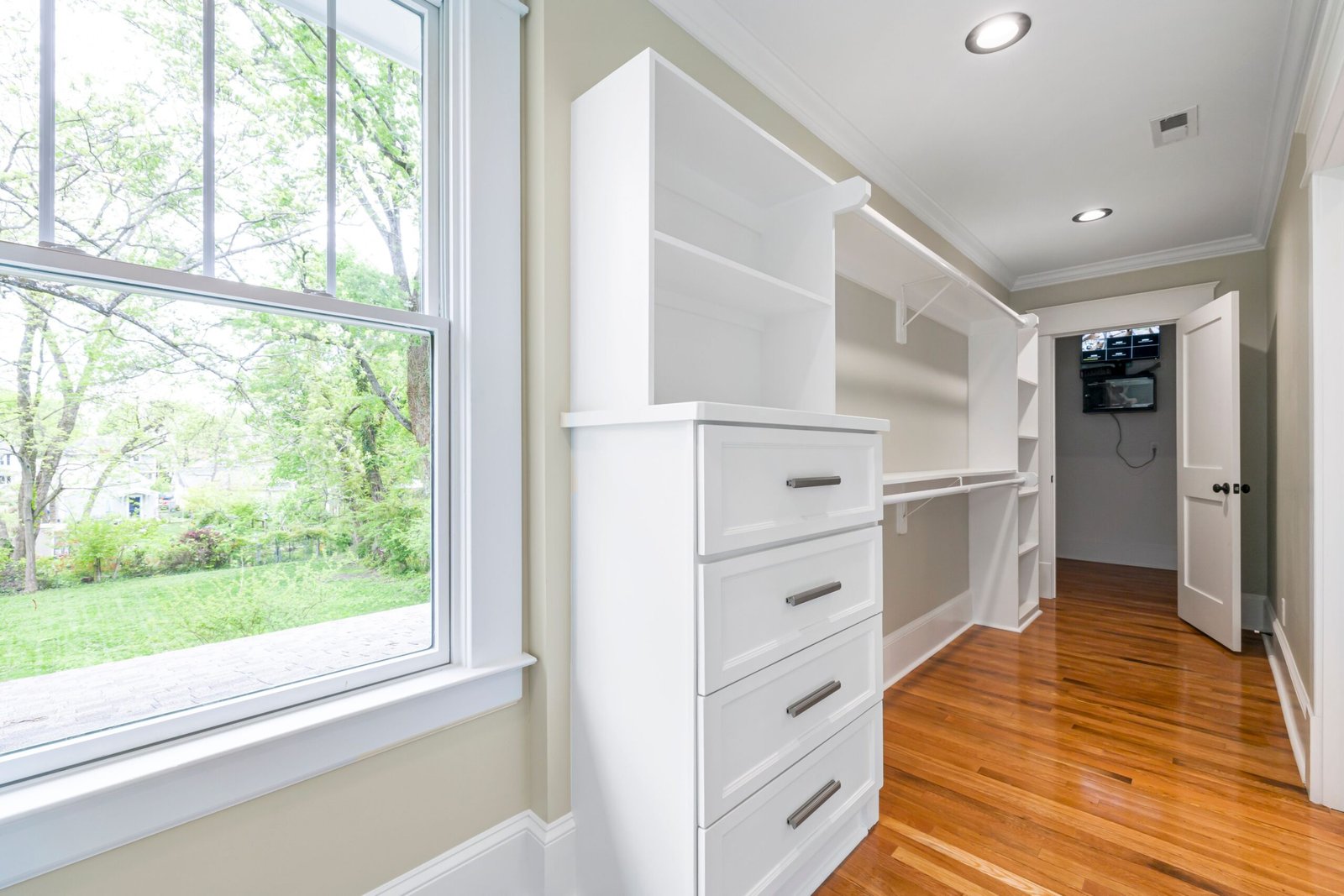
Closet drawers are drawers built into or placed inside a closet to store folded clothes, underwear, accessories, and other items that don’t hang well — turning dead closet space into organized, hidden storage.
They come in two flavors. Built-in closet drawers are part of a closet system or custom cabinetry — the drawer banks you see in walk-in closet photos, often with soft-close glides and matching fronts. Add-on closet drawers are freestanding or stackable units (drawer towers, rolling carts, under-shelf boxes) that you slide into an existing closet with zero construction. Both solve the same problem: they give foldables and small items a home where piles and bins used to live.
Why You’ll Love These Closet Drawer Ideas
- They hide visual clutter. Drawers close, and suddenly the closet reads as calm instead of chaotic — even when what’s inside is just “mostly sorted.”
- They fit any closet. Reach-in, walk-in, rental, owned — there’s a drawer solution for every layout and every lease agreement.
- They beat the dresser. A drawer tower inside the closet frees up bedroom floor space, which is gold in small rooms.
- They protect your clothes. Jewelry, belts, and delicates survive much better in divided drawers than in piles or on shelves.
- They’re genuinely affordable. You can transform a closet’s function for under $50 with stackable units and inserts — or go built-in when you own the walls.
Know Your Closet Drawer Types
Before you buy or build anything, learn the four drawer types. Matching the drawer to the contents is the difference between drawers you love and drawers you never open.
1. Shallow Closet Drawers for Small Stuff
Shallow drawers — roughly 4 to 6 inches deep — are the workhorses for socks, underwear, and accessories. Anything deeper turns small items into a pit where single socks go to vanish. If your closet drawers came with the system, reserve the shallowest ones for the smallest things.
The shallow drawer is also where dividers earn their keep. A 5-inch-deep drawer with a honeycomb insert holds an entire week’s worth of socks and underwear in plain sight, each pair in its own cell. Without the insert, the same drawer becomes a tangle within two laundry cycles.
Try it: empty your messiest small drawer, sort its contents into “socks,” “underwear,” and “other,” then add a $10–$15 insert before anything goes back in.
2. Deep Closet Drawers for Bulky Clothes
Deep drawers — 10 to 14 inches — are built for sweaters, hoodies, jeans, and sweatpants: the bulky foldables that collapse open shelves and eat dresser space. One deep drawer swallows what would be three wobbly shelf stacks, and the clothes stay put because the walls of the drawer hold the folds in place.
The trick with deep closet drawers is filing, not stacking. Stack clothes flat and you only ever see the top item; stand them upright in files and you see everything at a glance (more on the method in idea #14). Industry guides like ClosetWorld’s closet-with-drawers design walkthrough make the same point: deep drawers work when you plan what’s inside them, not just their dimensions.
Try it: move your bulkiest folded category — usually sweaters or jeans — from the shelf into your deepest drawer this week and see how much shelf you reclaim.
3. Pull-Out Closet Drawers on Smooth Glides
Pull-out drawers glide toward you on full-extension slides, so the back half of the drawer is actually usable — no more kneeling to reach the socks that migrated behind everything. In a closet, where the drawer often sits under a shelf or below hanging clothes, that pull-out action is what makes the storage reachable.
If you’re shopping for a system, full-extension glides are the spec worth paying for; cheap partial-extension slides leave a dead zone you paid for but can’t see. Soft-close is the nice-to-have on top — it stops the slam that chips watch faces and tangles necklaces in accessory drawers.
Try it: when comparing drawer units, open the drawer fully and check whether you can see and touch the back corners. If not, keep shopping.
4. Specialty Closet Drawers for Jewelry and Accessories
Specialty drawers are shallow drawers fitted with built-in organization: velvet-lined jewelry trays, watch rolls, ring slots, belt dividers, or tie racks. They exist because accessories are the first thing to disappear into chaos and the most annoying to replace.
You don’t need the expensive version to get 80% of the benefit. A standard shallow drawer plus a velvet liner and an acrylic tray gives you a jewelry drawer that keeps earrings paired and necklaces untangled. The lined drawer also stops the slide — unlined drawers let everything drift to the back corner within days.
Try it: dedicate your shallowest drawer to accessories only, line it with a $10 velvet drawer liner, and add one compartmentalized tray before the weekend.
Closet Drawer Units You Can Add to Any Closet
No built-ins? No problem. These four units bring closet drawers to whatever closet you have — including the one in your rental.
5. The Freestanding Closet Drawer Tower
A drawer tower is a vertical stack of 3 to 6 drawers, usually 18 to 24 inches wide, that stands on the closet floor or tucks between hanging sections. It’s the fastest way to add real closet drawers to a reach-in closet: carry it in, fill it, done. One tower replaces an entire dresser for most people’s foldables.
Measure before you buy — width, depth, and the clearance in front so drawers open fully. And anchor it: a tall tower loaded with jeans is a tip-over risk, especially with kids in the house. Use the furniture strap or anti-tip kit that comes in the box (or any wall anchor rated for the weight) and attach it to a stud.
Try it: sort one dresser drawer into “flat and small” versus “bulky” — the flat-and-small pile is exactly what belongs in a tower’s shallow drawers.
6. Under-Shelf Stackable Closet Drawer Units
These are small plastic or fabric drawer boxes that stack on the closet floor or under the existing shelf, usually 12 to 18 inches wide. They’re the budget hero of closet drawers: a three-pack costs less than a pizza dinner, and they slide right under the shelf that holds your shoes or bags.
Stackable units work best when you label them. Clear or frosted fronts let you see inside; solid fronts hide the mess — either way, a label on the front (“gym clothes,” “scarves,” “off-season”) is what keeps the system alive past month one. Buy the same unit twice rather than mixing brands: mismatched stacks wobble and look chaotic.
Try it: slide two stackable units under your closet’s top shelf today — one for accessories, one for off-season — and label both before you walk away.
7. Rolling Closet Drawer Carts
A rolling drawer cart is a narrow tower on casters that you can wheel in and out of the closet — perfect for closets that double as something else (the guest-room closet, the hallway closet) or for people who rearrange seasonally. Lock the casters once it’s parked; a cart that drifts is a cart that annoys you daily.
I like rolling carts for the categories that change: workout gear, project supplies, the “currently in rotation” pile. When the cart lives in the closet, it’s storage; when you need the closet for something else, the whole drawer bank rolls out in one motion. Look for carts with at least a 4-inch wheel — tiny casters catch on carpet and thresholds.
Try it: if your closet floor is currently “the pile zone,” park a rolling cart there for one week — piles that had nowhere to go suddenly have drawers.
8. Anchored Built-In-Style Closet Drawers
For owners (or committed renters with a drill), a wall-anchored drawer bank between two closet sections gives the custom built-in look without the custom price. These are cabinet-style drawer boxes — often unfinished wood or laminate — that you screw to the wall or to adjacent shelving so they can’t shift or tip.
The payoff is stability and capacity: anchored units can be wider and deeper than freestanding ones, and the top surface becomes a shelf for bags or a valet tray. Keep the drawer fronts consistent with the rest of the closet (paint them the same white as the shelving) and the whole thing reads as one intentional system.
Try it: if you own your place, price one 24-inch-wide drawer bank against the cost of a second dresser — the bank usually wins, and it doesn’t eat bedroom floor.
Closet Drawer Inserts That Do the Real Work
Here’s the honest truth about closet drawers: the drawers themselves are only half the system. Without inserts, every drawer trends toward a junk drawer within a month. These four inserts are what keep your closet drawers organized for years, not weeks.
9. Adjustable Dividers for Closet Drawers
Spring-loaded or expandable dividers turn one big drawer into custom compartments — socks on the left, workout tops on the right, nothing migrating across the middle. They’re the single highest-impact purchase for closet drawers because they adapt: slide them to new positions when your wardrobe changes with the seasons.
Bamboo expandable dividers are the sturdy pick; they stay put better than plastic ones and look good in nicer drawers. HouseDigest’s roundup of drawer organization essentials highlights the same logic: spring-loaded dividers plus vertical folding keep tee shirts and leggings upright instead of sliding into a heap. Measure your drawer’s interior before ordering — dividers are sold by expandable range, and “almost fits” slides around.
Try it: put dividers in your largest drawer first, split it into three zones, and assign each zone one clothing category for two weeks.
10. Honeycomb Inserts for Closet Drawers
Honeycomb inserts are grids of small fabric or plastic cells — usually 24 to 32 per insert — each sized for one pair of socks, one pair of underwear, or one rolled tie. They solve the exact problem that kills sock drawers: small items migrate, tangle, and hide. With a honeycomb insert, you see every pair the moment you open the drawer.
The washable fabric versions are the better buy for closet drawers since sock drawers collect lint and the occasional stray… everything. Shake them out monthly, toss them in the wash quarterly, and they last years. Size the insert to your drawer, not the other way around — one well-fitted insert beats two rattling ones.
Try it: count your everyday socks and underwear, buy a honeycomb insert with at least that many cells, and pair everything before it goes in.
11. Velvet Jewelry Trays for Closet Drawers
Velvet trays with ring rolls, necklace hooks, and earring slots turn a shallow drawer into a jewelry box that’s actually easier to use than a standalone one — because it’s right where you get dressed. The velvet (or velour) lining matters: it keeps metal from scratching and stops everything from sliding when the drawer opens and closes.
Stackable trays are the pro move for taller drawers: one layer for everyday pieces, a second sliding layer for the special-occasion stuff. Keep the trays in a single drawer near your getting-ready mirror so the whole morning routine happens in one spot. And skip the giant tray sets if your collection is modest — one well-organized tray you use beats three you never open.
Try it: gather every piece of jewelry from its current scattered locations (boxes, countertops, that one dish), put it all in one velvet tray, and donate or toss what’s broken.
12. Tray Dividers for Belts, Ties and Sunglasses in Closet Drawers
Belts, ties, and sunglasses share a problem: they’re long, thin, and tangle or scratch when loose. Shallow tray dividers — compartmentalized inserts with long slots — give each belt its own lane, each tie its own fold, each pair of sunglasses its own padded cell.
The belt version is the one people underestimate. A coiled belt uncoils and takes over a drawer; a belt laid flat in a divided tray stays put and stays crease-free. For sunglasses, look for trays with soft dividers — hard plastic edges scratch lenses over time. One drawer with three of these trays can replace an entire accessory shelf.
Try it: pull every belt out of wherever it currently lives (hook, pile, floor), lay them flat in one divided tray, and notice how many duplicates you own.
Small-Closet Drawer Solutions
Small closets need drawers the most and have the least room for them. These three ideas are built for reach-in closets, rental closets, and wardrobes where every inch counts.
13. The Under-Hang Double Closet Drawer Stack
Look at your closet: there’s dead space under your short-hang clothes (shirts, blouses, folded pants) between the hems and the floor. A two-drawer stack — 18 to 24 inches wide — slides right into that gap. You’re using space that was holding nothing but dust, and the drawers sit exactly where you need daily items.
Measure the clearance from the bottom of your hanging clothes to the floor before you shop; most short-hang leaves 24 to 30 inches, which fits two standard drawers. Keep the stack shallow (14 to 16 inches deep) so it doesn’t eat into the closet’s walk-in space or block the door swing.
Try it: tonight, measure the under-hang gap in your closet — if it’s over 20 inches, you have room for a drawer stack you didn’t know you had.
14. File-Fold Everything in Your Closet Drawers
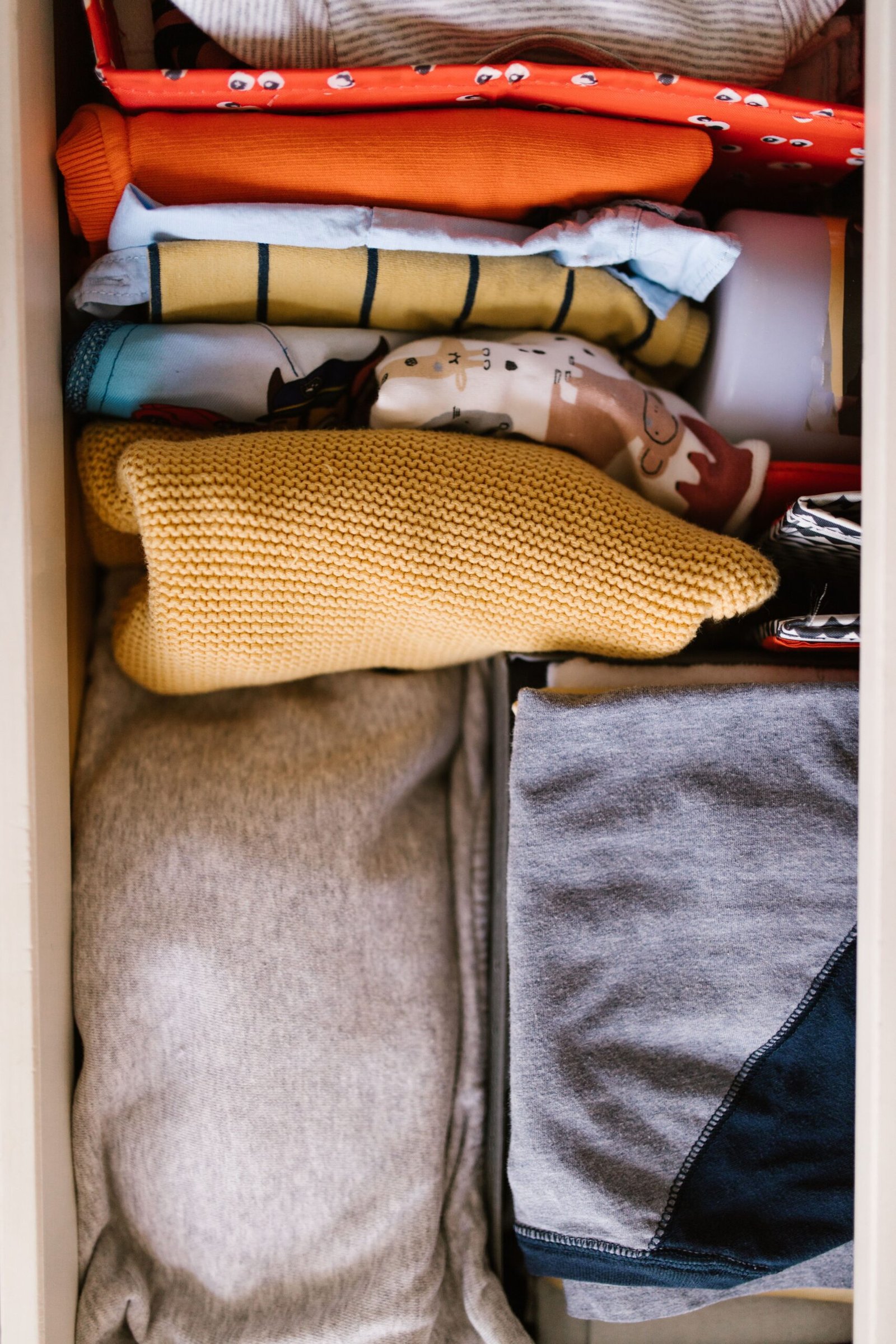
File folding — folding clothes into small rectangles that stand upright like files in a cabinet — is the method that makes closet drawers work. Stacked clothes hide everything below the top item; filed clothes let you see every single piece the moment you open the drawer. It’s the difference between using your whole wardrobe and wearing the same five shirts.
The fold is simple: fold each garment into a smooth rectangle, then fold it in half or thirds until it stands on its own edge. Line the rectangles up side by side in the drawer, heaviest fabrics toward the back. The first fold takes a minute to learn; by the tenth, it’s automatic. This is the method popularized by Marie Kondo’s KonMari approach, and it survives because it works in any drawer, any closet, with zero purchases.
Try it: file-fold one drawer of t-shirts this laundry day — you’ll fit roughly 30% more and actually see all of them.
15. One Category Per Closet Drawer, With Labels
The simplest system is the one that survives: one category per drawer, labeled on the front. “Workout,” “socks,” “sleep,” “jeans” — when every drawer has a job and the job is written on it, putting laundry away takes seconds and the system maintains itself.
Labels matter more than you’d think, especially in shared closets. A label maker, chalk labels, or even masking tape with a marker — the format doesn’t matter, the visibility does. Put the label on the drawer front where you see it before you open anything. And audit twice a year: when a drawer’s category stops matching what you actually own, reassign the drawer, not the habit.
Try it: label every closet drawer you own this weekend — even temporarily with tape. The ones that feel wrong to label are the ones that need rethinking.
Closet Drawer Care & Mistakes to Avoid
Drawers fail from neglect, not design. Twice a year, pull each drawer out fully, vacuum the tracks, and wipe the interiors — dust and lint are what make glides gritty and clothes dingy. Tighten any loose screws on pull-out units while you’re in there; a wobbly drawer becomes a broken drawer.
The mistakes I see most often: overfilling (a drawer that won’t close damages the glides and defeats the purpose — if it’s full, it’s time to declutter, not cram); no dividers (every undivided drawer becomes a junk drawer, it’s just physics); and wrong-depth drawers for the contents (socks in a 12-inch-deep drawer is a recipe for the sock pit). Fix these three and your closet drawers will still be organized next year.
Closet Drawers FAQ
How deep should closet drawers be?
Shallow closet drawers (4–6 inches) are best for socks, underwear, and accessories; medium drawers (7–9 inches) handle t-shirts and pants; deep drawers (10–14 inches) suit sweaters, jeans, and bulky items. If you only get one depth, go medium — it’s the most versatile.
How wide should closet drawers be?
For reach-in closets, 18–24 inches wide is the sweet spot — narrow enough to fit beside hanging sections, wide enough to hold folded clothes without awkward gaps. In walk-ins, 24–30-inch drawer banks look built-in and hold more per drawer.
Can you put drawers in a rental closet?
Yes — freestanding drawer towers, stackable under-shelf units, and rolling carts all add closet drawers with zero drilling. Just anchor tall towers with a removable furniture strap for safety, and check your lease before screwing anything to the wall.
Are closet drawers better than shelves?
For foldables and small items, yes: drawers hide clutter, keep stacks from toppling, and use vertical space more efficiently. Shelves win for bags, shoes, and display items you want to see. Most great closets use both — drawers for clothes, shelves for everything else.
How do you organize deep closet drawers?
File-fold clothes so they stand upright and visible, then add adjustable dividers to create zones — one category per zone. For socks and underwear, use a honeycomb insert. Never stack clothes flat in a deep drawer; you’ll only ever see the top item.
What’s the cheapest way to add drawers to a closet?
Stackable fabric or plastic drawer units run $15–$30 for a set and slide under the existing shelf — the lowest-cost way to add real closet drawers. Add a $10 honeycomb insert to the top drawer and you’ve organized the messiest category in your closet for under $40 total.
Conclusion
Closet drawers are the highest-leverage upgrade in any closet: they hide clutter, protect your clothes, and turn dead space into storage that actually works. Start with one drawer tower or a set of stackables, add dividers and a honeycomb insert, and file-fold what goes inside. Your closet will feel twice as big — and getting dressed will finally feel calm.

Founder of NestFlavors — sharing tested recipes and honest home ideas, made for real life.