
I once counted 23 separate bottles on my bathroom counter — and I use maybe six of them.
That was my wake-up call. For years my vanity looked like the clearance aisle of a drugstore: half-empty serums I stopped using in 2022, three kinds of hand soap, a toothbrush graveyard, and a candle I never lit because lighting it meant moving six things first. The counter was only 36 inches wide, yet it held an entire pharmacy. Sound familiar? A good bathroom counter organizer isn’t a storage box you buy — it’s a decision about what earns a spot on that tiny piece of real estate you touch twice a day.
I’ve since tested nearly every style of organizer out there: trays, turntables, tiered stands, apothecary jars, decanted bottle sets, divided caddies. Some earned their place permanently; some looked pretty in the product photo and lasted a week in my bathroom. Below are the 14 bathroom counter organizer ideas that actually survived real mornings — sticky toothpaste caps, wet hands, and all. You’ll also get my declutter-and-zone method, the mistakes that undo every organized counter, and honest answers to the questions I get asked most.
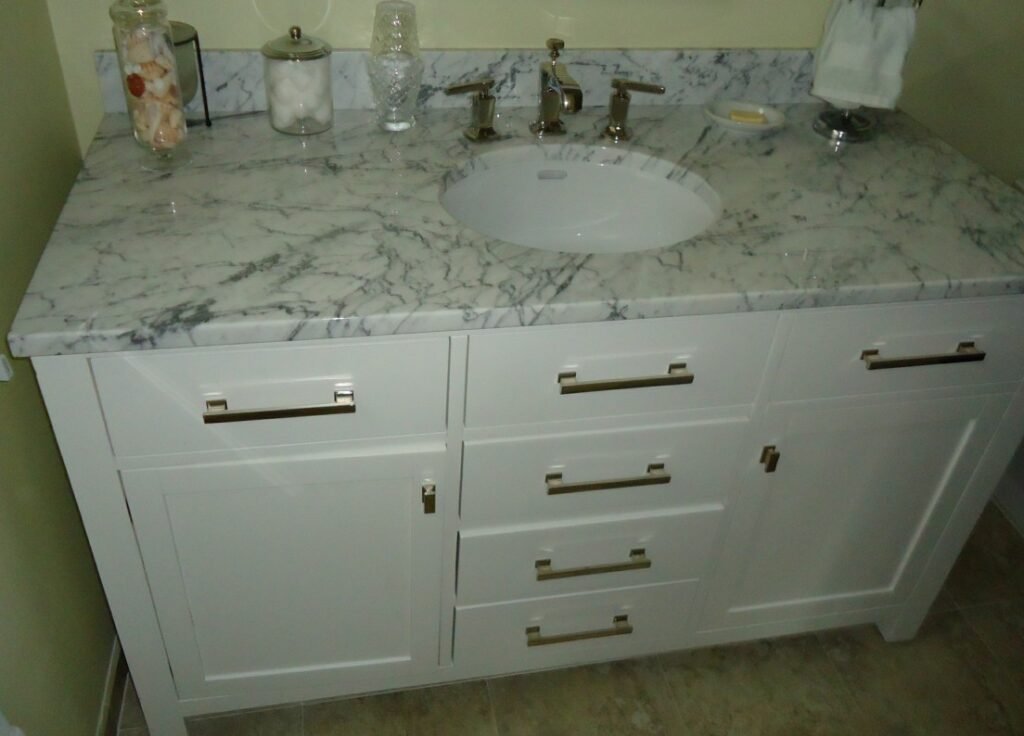
Trays That Make Clutter Look Intentional
The single fastest upgrade you can make is also the cheapest: containment. A tray turns a scattered pile into a “display.” Psychologists would say it creates visual grouping; I say it just looks like you meant it. Every serious bathroom counter organizer setup I’ve ever admired starts with one of these three.
1. The Contained Vanity Tray
One rectangular or oval tray, sized to hold your daily essentials and nothing else, is the entire foundation of an organized counter. Mine is a matte ceramic tray about ten inches wide that holds hand soap, a lotion pump, and one small candle — three items, done. The magic is the boundary: anything that doesn’t fit on the tray doesn’t belong on the counter. When cleaning day comes, I lift the whole tray, wipe the counter in one pass, and set it back down. That alone is worth the purchase.
Try it: measure your counter’s dry zone first, then buy a tray that leaves at least half the counter bare — a tray wider than your elbow room becomes clutter with edges.
2. The Two-Tier Tray
When you need the tray look but have more than five daily products, a two-tier tray stacks the real estate instead of spreading it. The lower level holds the heavy daily drivers — cleanser, moisturizer, toothpaste — while the upper tier gets the prettier, lighter items like a small perfume bottle or a rolled washcloth. I like these because they give you a focal point instead of a flat sprawl, and guests always assume the bathroom is cleaner than it is.
Try it: put your most-used items on the bottom tier where your hand naturally reaches, and treat the top tier as the “pretty but optional” shelf.
3. The Ring Dish Landing Zone
This isn’t really an organizer for products — it’s an organizer for the random stuff that migrates onto the counter during the day. A small ceramic or stone dish by the faucet catches rings, earrings, hair ties, and the watch you take off to wash your face. Before I added one, my jewelry lived in a sad puddle next to the soap; now it lives in a dish that looks intentional. Pick one with a raised rim so nothing slides off, and keep it on the dry side of the sink, away from the drain. It is the smallest bathroom counter organizer in this list, and it fixes the one category of mess that trays and towers never catch.
Try it: if you never wear rings, use the same dish for bobby pins and hair clips — the “landing zone” principle works for any daily scatter.
Go Vertical: Tiered & Spinning Storage
Most counters are short on width and long on wasted air above them. Tiered organizers and turntables use that vertical space so you stop lining every bottle in a single row like a police lineup. As a bathroom counter organizer category, these are the hardest workers per square inch.
4. The Tiered Countertop Stand
A two- or three-level metal or bamboo stand is basically a tiny set of shelves for your skincare routine. I keep my morning routine on the bottom tier in order of use — cleanser, toner, serum, moisturizer, sunscreen — and it genuinely sped up my mornings because I stopped hunting for the next bottle. The middle tier holds weekly treatments like exfoliating masks, and the top gets one decorative item so it doesn’t look like a lab bench. Keep the footprint narrow, around eight inches, so it doesn’t eat the whole counter.
Try it: arrange products back-to-front by height, tallest in back, so every label stays readable without moving anything.
5. The Lazy Susan Turntable
I resisted the turntable for years because it felt like a kitchen gadget, and then I put my most-used hair products on one and stopped reaching behind things forever. One spin brings the back row to the front — no more knocking over the hairspray to reach the dry shampoo. For a bathroom counter organizer that handles tall, tippy bottles, nothing beats a low-profile turntable with a raised lip edge. It’s also the kindest option for shared bathrooms, where everyone has their own section and nobody has to touch anyone else’s stuff to find their own.
Try it: dedicate one half of the turntable to hair and the other half to body, so the spin always lands you in the right department.
6. The Slim Corner Tower
Corners are dead space on most vanities — too far from the faucet to be convenient, too visible to ignore. A slim triangular or narrow rectangular tower with three or four small shelves turns that corner into the highest-density storage on the counter. Mine holds cotton rounds, a contact lens case, tweezers, and the tiny odds and ends that otherwise drift. Because it’s vertical and narrow, it reads as architecture rather than clutter, and it fits counters as small as 24 inches wide.
Try it: use the top shelf for the one item you reach for half-asleep — mine is the contact case — and work downward by frequency of use.
Decant It: Jars, Bottles & Canisters
Here’s a truth nobody selling organizers will tell you: half of counter clutter is packaging, not products. Brand bottles come in clashing colors, clashing heights, and labels that scream at each other. Decanting — moving products into containers you chose — is the cheapest visual upgrade in this entire list. This is the bathroom counter organizer approach that looks expensive without spending much.
7. The Apothecary Jar Trio
Three glass apothecary jars in graduated sizes turn your least glamorous supplies into decor. Mine hold cotton balls, cotton swabs, and bath salts, and visitors consistently assume I have my life together — I do not, I just have jars. The glass shows off the contents, which means you get a visual inventory at a glance and never discover you’re out of cotton rounds mid-makeup. Use lids with a good seal, because bathroom steam and humidity will wilt open cotton products faster than you think. The whole trio is a bathroom counter organizer that doubles as decor — no plastic in sight.
Try it: keep it to three jars maximum on a small counter; a row of six reads as a museum exhibit, not a vanity.
8. Decanted Matching Pump Bottles
Take your mismatched hand soap, lotion, and whatever else lives in loud plastic packaging, and pour them into two or three matching pump bottles in glass, ceramic, or amber. This single move removed about 80% of the visual noise from my counter the day I did it. As a bathroom counter organizer strategy, decanting works because it shrinks color chaos: instead of seven brands competing for your eye, you see two or three calm, uniform vessels. Choose pumps with waterproof labels or no labels at all, and keep the original bottles under the sink for refills.
Try it: start with just soap and lotion — the two products that sit closest to the faucet and get seen most. The rest can stay in their bottles.
9. Lidded Canisters for the Odds & Ends
Some things are too ugly to display and too necessary to hide: floss picks, spare razors, hair ties, travel-size everything. One or two lidded canisters — ceramic, frosted glass, or even a nice opaque plastic — swallow all of it and sit on the counter looking like they belong. I use a small canister with a wooden lid for hair ties and bobby pins, and the difference between “a pile of rubber bands” and “a canister” is the difference between chaos and calm. The lid matters: open cups collect dust and steam; lids keep contents clean and dry.
Try it: assign one canister per category, not per person — “hair stuff,” “dental,” and “extras” — so anyone in the house can find things by logic instead of memory.
Shared & Small-Space Savers
Everything above assumes a reasonably sized counter and one person’s stuff. Real bathrooms are smaller and more crowded. These five bathroom counter organizer ideas are the ones I recommend when the counter is tiny, the bathroom is shared, or both.
10. The Divided Daily Caddy
A divided caddy with a handle gives every category its own compartment — oral care here, skincare there, grooming tools in the middle — and the handle means you can lift the whole kit into a drawer or cabinet when guests come over. This is the workhorse of shared bathrooms: one caddy per person, and the morning rush stops being a territorial dispute. Pick a caddy in one calm color so the divided sections don’t multiply the visual clutter they’re meant to tame. Think of it as the bathroom counter organizer for households running more than one morning routine.
Try it: if the bathroom is shared, assign each person a caddy color or add a simple label — “one row per person” ends more arguments than you’d expect.
11. Clear Acrylic Stackers
When space is truly tight, clear stackable drawers or tiered acrylic bins let you see everything without opening anything. They’re not the prettiest option on this list, but for countertop storage in a shared family bathroom, visibility beats beauty — nobody has to rummage through your stuff to find their own. Keep the stackers small (two or three drawers max), because tall clear towers start to look like an office supply closet. Wipe them down weekly; acrylic shows water spots. It is the least glamorous bathroom counter organizer here, and in a family bathroom it may be the most useful.
Try it: dedicate one drawer to “right now” items and the lower ones to this week’s rotation, so the top drawer is always the fast grab.
12. The Slim Wall Ledge
Sometimes the best bathroom counter organizer isn’t on the counter at all. A slim adhesive or screw-mounted ledge under the mirror — eight to ten inches long — lifts perfume, skincare, or daily vitamins off the counter entirely. This move freed nearly a third of my small vanity, and because renters can do it with removable adhesive strips, there’s no landlord negotiation involved. Keep heavy glass bottles off it; light daily items are the sweet spot.
Try it: mount the ledge at mirror height on the side opposite your dominant hand, so you reach across less and knock things over less.
13. The Divided Toothbrush Cup
The humble toothbrush cup deserves an upgrade: a divided cup with two or three compartments holds toothbrushes, toothpaste, and a tongue scraper in one neat footprint instead of three leaning objects. Choose ceramic or stainless steel so it can be rinsed often, and pick a tall, narrow profile — it uses less counter than a wide-mouth jar. For families, two narrow cups beat one crowded cup every time, because nobody’s brush touches anyone else’s.
Try it: rinse the cup every Sunday with your weekly wipe-down — it’s the single grossest spot on most counters, and nobody thinks about it.
14. The Nightly Reset Spot
My favorite organizer costs nothing: one deliberately empty patch of counter, about the size of a paperback, reserved for the things that appear during the day. The watch you take off, the retainer case, the skincare tube you used at night. When everything has a parking spot, random objects stop colonizing the entire counter. This is the habit that keeps every other bathroom counter organizer working — without a reset spot, even a perfectly trayed counter drifts back to chaos within a week.
Try it: pick the corner nearest the door, and make putting things “in the spot” part of your bedtime routine. Ten seconds, every night.
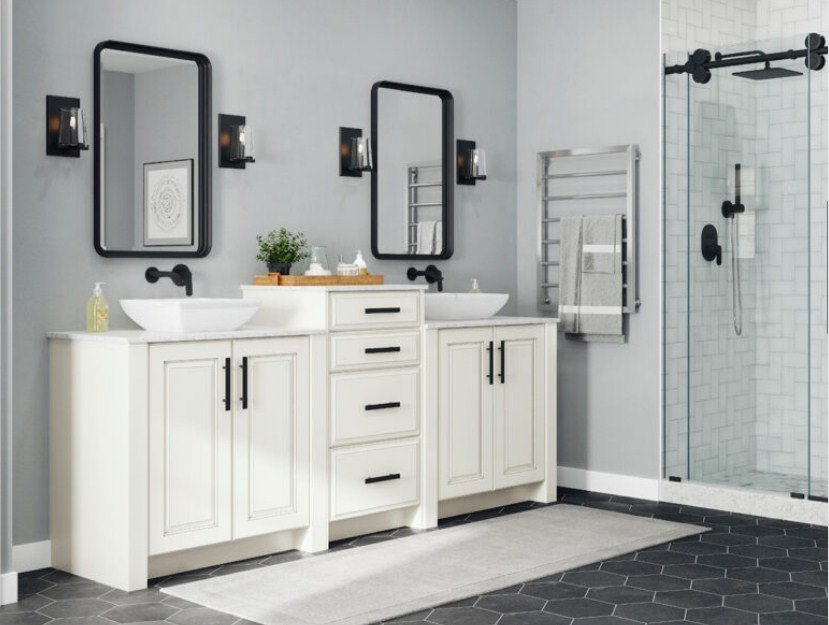
How to Declutter and Zone Your Counter Like a Stylist
An organizer can’t fix a counter that’s holding three times what it should. Before you buy anything, do the purge — and then set up zones so the counter stays organized instead of drifting back to chaos by Thursday. A bathroom counter organizer only works when what’s inside it was chosen on purpose.
Start with the one-hour reset I use on every bathroom I help with. Pull everything off the counter and sort it into three piles: daily (used every single day), weekly (used at least once a week), and everything else. The daily pile goes back on the counter, in an organizer, zoned by task. The weekly pile goes into a drawer, a cabinet, or an under-sink bin with drawer dividers. The third pile — the duplicates, the expired samples, the serum from two years ago, the hotel minis — leaves the bathroom entirely. Be ruthless here: if you haven’t touched it in a month, it is not a daily item no matter how expensive it was.
Now zone what’s left. The wash zone sits closest to the faucet: soap, toothbrush cup, hand towel. The beauty zone sits on the dry side: skincare, makeup, hair products, grouped in your tray, turntable, or tiered stand. And leave one small decor moment — a candle, a tiny plant, one framed photo — because a counter that’s all function feels like a dentist’s office. The 50% rule keeps it honest: at least half the counter should stay visibly clear. If your organizers cover more than half, you kept too much.
Here’s my keep-out versus store-away list, refined over years of trial and error. Keep out: hand soap, toothbrushes, your actual daily skincare (not the aspirational kind), one hand towel, one scent item, one catch-all dish. Store away: backup products, hair tools, extra skincare, razors, medicine, cleaning supplies, full makeup bags, and anything with a “use by” date you can’t see. Backups belong under the sink or in a linen closet — the counter is for the current lineup, not the inventory. Treat the counter like a stage and your bathroom counter organizer like stage furniture: if an item isn’t performing daily, it goes backstage.
One last rule: respect the wet zone. The six inches around the faucet is a splash area, and cotton, jewelry, wood, wicker, and paper labels all suffer there. Put your lidded jars, your canisters, and your ring dish on the dry side, and the whole setup lasts longer and cleans faster.
Common Mistakes to Avoid
I’ve watched friends buy beautiful organizers and still end up with a messy counter — and I’ve done it myself. Here are the six mistakes that undo every organized bathroom, and the fix for each.
Mistake 1: Buying the Bathroom Counter Organizer Before the Purge
The problem: you bring home a gorgeous tray set, arrange all 23 bottles in it, and the counter looks organized for exactly four days — because there was never room for 23 bottles in the first place.
The fix: purge first, measure second, buy last. The organizer should fit your edited routine, not your entire product history.
Mistake 2: Sizing for the Store Shelf, Not Your Counter
The problem: the tiered stand looked perfect in the store and swallows your entire 24-inch vanity at home, leaving no room for your hands, let alone the soap.
The fix: measure your counter’s usable width and depth before shopping, and bring a tape measure to the store. If the organizer is wider than half your counter, it’s the wrong one.
Mistake 3: Ignoring the Splash Zone
The problem: cotton rounds go soggy, labels peel, and wooden organizers warp because everything sits within the faucet’s splash radius.
The fix: map where your faucet actually sprays — run the water and watch — then keep absorbent and wood items outside that radius, ideally on the far side of the sink.
Mistake 4: Mixing Five Different Finishes
The problem: a bamboo tray, a chrome turntable, a marble soap dish, a brass cup, and a plastic caddy all technically organize — and together they look like a rummage sale.
The fix: pick two finishes maximum (say, ceramic and one metal) and repeat them. Cohesion is what makes a counter look styled rather than merely sorted. Every bathroom counter organizer you own should look like it came from the same household, if not the same store.
Mistake 5: Keeping Backups on the Counter
The problem: the counter holds the current shampoo plus its backup, the current lotion plus its backup, and suddenly half your storage is inventory management.
The fix: one active product per type on the counter, period. Backups live under the sink, in a cabinet, or in a labeled bin — anywhere with a door.
Mistake 6: Making It Impossible to Clean Under
The problem: the organizer is so sprawling and multi-piece that wiping the counter means disassembling a puzzle, so you just… don’t. Grime builds up underneath for months.
The fix: choose organizers you can lift in one motion — a single tray, a caddy with a handle — and wipe the counter underneath weekly. If cleaning takes more than a minute, the system is too complicated.
Bathroom Counter Organizer at a Glance
Fourteen ideas is a lot to hold in your head while shopping, so here’s the cheat sheet: the category, my pick for each, and when it makes sense.
| Category | Best Pick | When to Use It |
|---|---|---|
| Flat containment | Vanity tray | Any counter — the universal starting point for an intentional look |
| Flat containment | Two-tier tray | When you have 5–8 daily products but a narrow counter |
| Flat containment | Ring dish landing zone | Daily jewelry, hair ties, and watch-wearing routines |
| Vertical storage | Tiered countertop stand | Skincare routines with many steps; small counters needing density |
| Vertical storage | Lazy Susan turntable | Tall bottles you reach past daily; shared bathrooms |
| Vertical storage | Slim corner tower | Dead corners on 24-inch vanities; tiny odds and ends |
| Decanted storage | Apothecary jar trio | Cotton balls, swabs, bath salts — supplies that look good visible |
| Decanted storage | Matching pump bottles | Clashing brand packaging near the faucet (soap, lotion) |
| Decanted storage | Lidded canisters | Ugly-but-necessary items: floss picks, razors, hair ties |
| Shared / small-space | Divided daily caddy | Shared bathrooms — one caddy per person ends the turf wars |
| Shared / small-space | Clear acrylic stackers | Family bathrooms where visibility matters more than style |
| Shared / small-space | Slim wall ledge | Tiny vanities; renters who can’t drill |
| Shared / small-space | Divided toothbrush cup | Oral care for one or two people in a small footprint |
| Shared / small-space | Nightly reset spot | Every bathroom — the free habit that protects the whole system |
FAQ
What is the best bathroom counter organizer for a small vanity?
A single narrow tray combined with one vertical piece — a slim tiered stand or a small turntable — is the best bathroom counter organizer setup for a small vanity. The tray handles daily essentials, the vertical piece adds capacity without spreading out, and together they should cover no more than half the counter. Measure your usable width first; on a 24-inch vanity, anything over ten inches wide in any direction starts to crowd.
How do I keep my bathroom counter from getting cluttered again?
The purge is the easy part; maintenance is the whole game. Do a five-minute nightly reset — everything back in its organizer, everything in the reset spot parked — and a weekly wipe-down where you toss empties and expired samples. The one-in-one-out rule helps too: a new product only earns counter space if something else leaves the counter for the cabinet.
Should I use a tray or a caddy as my organizer?
It depends on how the bathroom is used. A tray is best for one person’s stable routine — it looks styled and cleans up in one lift. A divided caddy is best for shared bathrooms or routines in flux, because the compartments and handle make it portable and assignable. If you genuinely can’t decide, start with the tray; it’s cheaper and it teaches you what you actually use daily.
What materials hold up best near a bathroom sink?
Ceramic, glass, stainless steel, and sealed stone are the safest bets — they shrug off water and wipe clean. Sealed bamboo and teak look warm and work fine if you wipe them dry and give them airflow, but raw wood and natural wicker warp and mildew in the splash zone. Acrylic is practical and affordable, though it shows water spots and scratches over time, so it’s better for shared bathrooms than showpiece vanities.
How do you organize a bathroom counter you share with someone?
Give each person their own contained zone: one caddy or tray per person, plus one shared item (the soap dispenser). Divided and clear organizers work best because nobody has to dig through the other person’s products. Keep the shared zones — soap, hand towel — in the middle, and put personal zones on each person’s side of the sink.
Is it really worth decanting products into matching bottles?
For the two or three products closest to the faucet — hand soap, lotion, maybe mouthwash — yes, absolutely. Those are the most visible items on the counter, and uniform bottles remove most of the visual noise in one move. For everything else, decanting is optional; don’t let a pretty-bottles project become an excuse to keep products you should have purged.
Where should I place an organizer so it doesn’t get splashed?
Watch where your faucet actually sprays, then place organizers outside that radius — usually the far side of the sink or the back corner. Tall items go in back, short items in front, and nothing absorbent (cotton, paper, wood, jewelry) sits in the direct splash line. If the counter is so small that everything gets splashed, choose lidded and waterproof organizers and wipe the area dry daily.
How often should I declutter my bathroom counter?
Do a quick weekly edit — toss empties, expired samples, and anything that crept in — and a deeper seasonal purge where you re-audit every product against the “used it this month” test. Most counters drift because of slow accumulation: one new product a month, nothing ever leaving. A standing monthly five-minute audit keeps the drift from becoming a rebuild.
Final Thoughts
An organized bathroom counter isn’t about buying the prettiest tray on the internet — though I’ll admit a good tray helps. It’s about deciding, on purpose, what lives on the small patch of counter you use every morning and every night. Purge first, zone by task, pick one bathroom counter organizer style that fits your actual routine (not the aspirational one), and give the whole system a five-minute reset each night. Do that, and the calmest room in your house might just be the bathroom — which, on a chaotic morning, is worth more than any renovation.
Also Read: 12 Best Christmas Shower Curtain Ideas (Festive 2026)
Also Read: 15 Best Kitchen Shelves Ideas for Stylish Open Shelving
Also Read: 15 Best Floor Mirror Ideas (Buying & Styling Guide)

Founder of NestFlavors — sharing tested recipes and honest home ideas, made for real life.