
Every cozy home has a dirty little secret: a mountain of blankets with nowhere to go.
I have been there more times than I care to admit. The throw blanket that started life neatly folded on the arm of my sofa somehow multiplied into six, and now they live in a permanent heap on the ottoman, the dining chair, and — I am ashamed to say — the floor beside the couch. If your living room looks like a bedding department, you do not have a blanket problem. You have a blanket storage problem.
Here is what I have learned after years of styling small living rooms and bedrooms: blankets do not clutter a room — unstored blankets do. Give every throw a designated home, and the whole house feels calmer. This guide rounds up 12 blanket storage ideas that actually work in real homes, from woven baskets that keep throws grab-ready to closet tricks that keep your wool safe through summer. Whether you want your blankets on display or tucked out of sight, there is a landing spot here for every single one.

What Is Blanket Storage?
Blanket storage is any system — furniture, container, shelf, or wall-mounted rack — that gives your blankets a designated place to live when they are not warming someone’s lap. Good blanket storage does two jobs at once: it keeps throws organized and easy to reach, and it protects fabrics from dust, damp, and moths.
The key insight most people miss: blankets need different storage than clothes. They are bulky, they get used daily, and they look better when they are slightly visible. The best blanket storage ideas respect all three of those truths instead of fighting them.
Why You’ll Love These Blanket Storage Ideas
- Ten-second tidy-ups: when every blanket has a home, “cleaning up” means tossing throws in a basket — not hauling them up the stairs.
- Your rooms look bigger: stray blankets create visual noise. Contained blankets read as intentional styling.
- Throws stay cleaner: floor-dwelling blankets collect dust and pet hair. A basket or shelf keeps them one notch fresher.
- Fabrics last longer: proper blanket storage protects wool and cotton from moths, mildew, and sun fading.
- No new furniture required: several of these ideas use baskets, hooks, and space you already own.
- Renter-friendly: every single idea here works without drilling a single hole if you need it to.
Blanket Storage Ideas That Double as Decor
Some blankets deserve to be seen. If you reach for a throw daily — the one on your favorite reading chair, the kids’ movie-night blanket — do not bury it in a closet. These blanket storage ideas keep everyday throws within arm’s reach while making your room look better, not busier.
1. The Oversized Woven Basket
This is the undisputed champion of blanket storage, and I will die on this hill. One large woven basket beside the sofa holds four to five throws, and cleanup is literally a toss. Look for a basket with a wide mouth and a sturdy base — narrow baskets turn into a game of throw-blanket Jenga.
Here is the move that makes it look styled instead of stuffed: roll each blanket into a loose tube instead of folding it. Rolled throws stand upright like scrolls, you can see every color at a glance, and you can pull one out one-handed without disturbing the rest. Natural fibers like seagrass, jute, and rattan add warmth to the room, and the open weave lets air circulate so nothing gets musty.
Try it: place the basket within arm’s reach of your main seat and commit to the “one in, one out” rule — no new throws until the basket is not overflowing.
2. A Leaning Blanket Ladder
A blanket ladder — basically a tall wooden ladder leaned against the wall — turns your prettiest throws into wall art. Drape two or three blankets over the rungs, alternating colors and textures, and suddenly you have a display piece that costs less than most art prints.
Ladders shine in tight corners and beside bookshelves where floor baskets would crowd the walkway. They are also the rare storage piece that works for heavy quilts, which tend to collapse in baskets. Paint it, stain it, or leave it raw to match your style — and if you have a cat, accept now that the bottom rung is the cat’s rung.
Try it: anchor the ladder with felt pads behind the top rails so it never slides on hardwood, and keep the heaviest blanket on the lowest rung for stability.
3. Drape Them Like You Mean It
The simplest blanket storage idea of all is to stop “storing” your favorite throw and start styling it. A blanket folded lengthwise and draped over the sofa arm or the foot of the bed looks intentional, adds color and texture, and stays exactly where you will reach for it tonight.
The difference between “styled” and “sloppy” is the fold. Fold the throw into thirds lengthwise first, then drape it — the crisp lines make it read as a design choice. This trick works best with your two or three prettiest blankets; the ratty-but-beloved one stays in the basket, and that is fine.
Try it: color-match your draped throw to one other textile in the room (a pillow, a rug) and the whole vignette will click into place.
4. Open Shelf Stacks
If you own a bookshelf or open cabinet with even a little breathing room, you own a blanket storage unit. Neatly folded throws stacked on open shelves soften the hard lines of books and boxes, add a layer of texture, and put seasonal blankets right where you can see them.
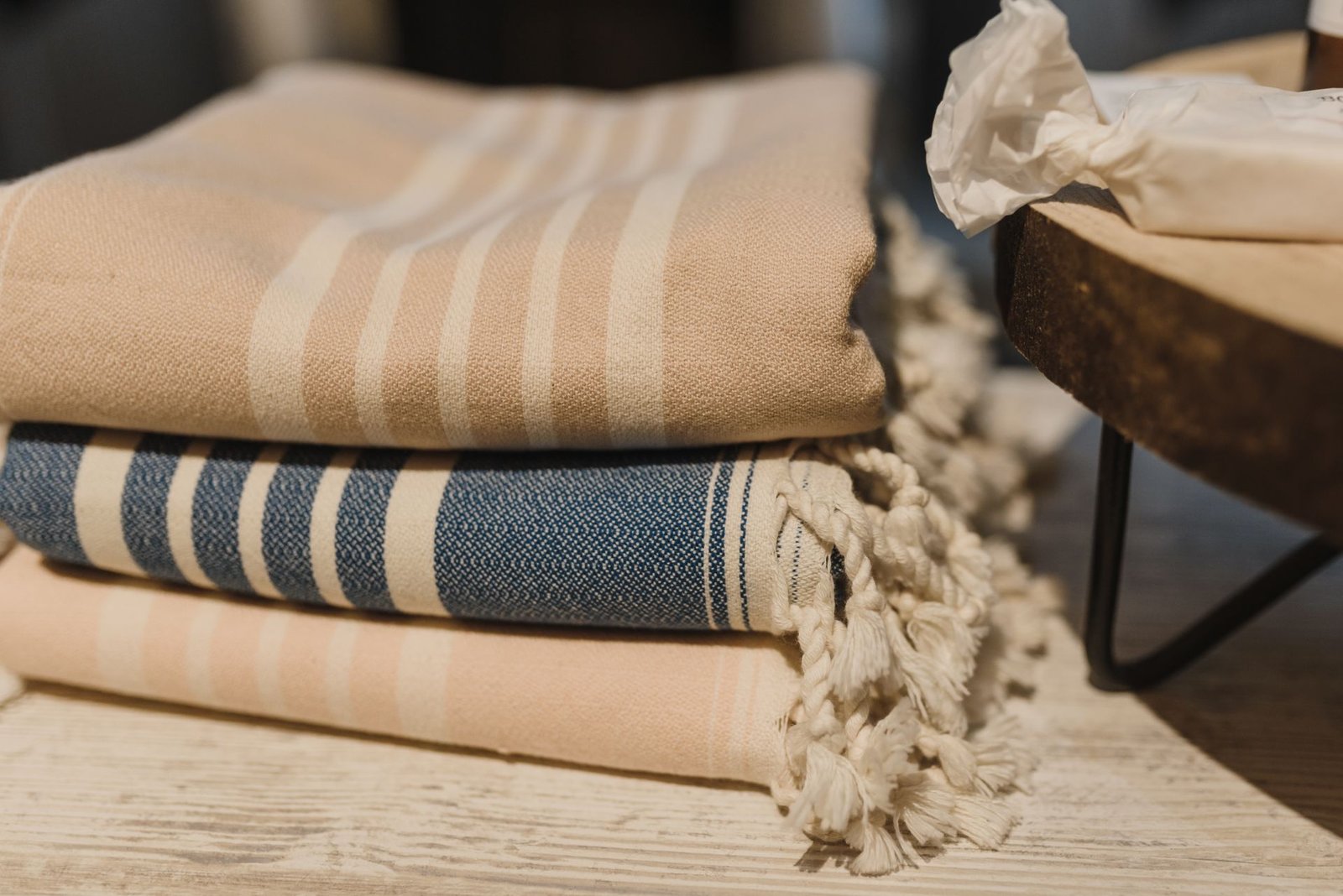
Shelf dividers or small storage cubes keep stacks from toppling, and grouping by color turns a functional shelf into a styling moment. This is my favorite spot for the guest-room extras and the heavier winter throws you only need four months a year. In a linen closet, the same idea applies on a bigger scale — folded stacks with the heaviest blankets on the bottom.
Try it: limit stacks to three or four throws so the shelf still feels airy, and slip a cedar ring or sachet behind the stack to keep moths away from wool.
Blanket Storage Ideas That Hide the Clutter
Display is great for your two favorite throws. The other nine — the bulky comforter, the scratchy-but-sentimental quilt, the spare set for guests — need to disappear. These hidden blanket storage ideas tuck everything out of sight in furniture you were going to buy anyway.
5. The Storage Ottoman at the Foot of the Bed
A storage ottoman is the hardest-working piece in my bedroom, and it is not close. Ours holds two full-size quilts and three throws, doubles as the seat I use to put on shoes, and catches the decorative pillows every night so they stop migrating to the floor.
Ottomans are ideal for off-season bedding because they seal out dust while staying accessible — no digging through a closet, no vacuum-seal drama. Look for one with a hinged lid that stays open on its own (soft-close hinges are worth it) and check the weight rating if you plan to actually sit on it. Bonus points if the upholstery is washable, because life happens.
Try it: store seasonal blankets in cotton bags inside the ottoman so wool never touches upholstery directly — and toss in a cedar block before you close the lid for winter.
6. A Blanket Chest or Trunk
Some storage pieces are heirlooms waiting to happen. A wooden blanket chest at the foot of the bed or in a hallway swallows a shocking volume of bedding — think two comforters and a stack of throws — while looking like a deliberate furniture choice rather than a storage unit.
Cedar chests are the classic pick for a reason: cedar naturally repels moths, which makes them the best long-term home for wool and cashmere blankets. If you inherit one, let it air out before use — old cedar can smell strong. For non-cedar chests, tuck a few cedar blocks inside and you get most of the same protection. Pro tip: a chest with a lid that doubles as a bench gives you seating in a hallway or window nook at the same time.
Try it: place your least-used blankets at the bottom of the chest and the ones you grab monthly on top, so you are never unpacking the whole thing.
7. Slide Storage Under the Bench
That dead zone under a hallway bench or entryway seat is premium real estate. Low woven bins or lidded boxes slid underneath turn wasted inches into blanket storage that nobody knows is there — I keep a spare throw in ours for guests who always end up chilly on the couch.
This works beautifully in entryways and reading nooks where a full basket would block foot traffic. Measure the clearance first (baskets are always taller than you think), and choose bins with handles so you can pull them out without crawling. Lidded versions keep dust off seasonal throws you only touch twice a year.
Try it: match the bin material to the bench — wicker under a wooden bench, fabric cubes under an upholstered one — so it reads as one piece of furniture.

8. The Storage Coffee Table and Side Table
Double-duty furniture is a small-space superpower, and the storage coffee table is its finest example. A lift-top coffee table swallows two folded throws, keeps the remote chaos out of sight, and still holds your coffee. Nobody at movie night will ever know the blankets are in there.
Side tables pull the same trick on a smaller scale. A lidded basket side table — essentially a tall basket with a tray for a lid — stashes one or two throws next to your chair and gives you a place to set your mug. Hunker has covered this exact DIY pairing, and it genuinely works. Even a coffee table with an open lower shelf counts: roll throws in a shallow basket and slide it underneath.
Try it: keep the coffee table throws to your daily-use ones — seasonal bedding belongs deeper in the closet, not under the remotes.
Closet and Seasonal Blanket Storage Ideas
Everyday throws live in baskets. But what about the bulky duvet, the wool blankets you only use in January, and the guest-room bedding waiting for its next visitor? These blanket storage methods are built for the long game: protecting fabrics for months at a time without turning your closet into a blanket avalanche.
9. Roll, Do Not Fold
This is the single technique that upgrades every other idea on this list. Rolling blankets instead of folding them compresses them slightly, eliminates hard crease lines, and lets you pack more into every basket, shelf, and bin. Fold the blanket into thirds lengthwise, then roll it from one short end like a sleeping bag.
Rolled blankets also stand upright in tall baskets — a trick organizers call “file folding,” and it means you can see and grab any throw without lifting the whole pile. This method is especially kind to down and synthetic fills, which bounce back from a loose roll far better than from months under a folded stack. Cotton throws roll beautifully; heavy wool blankets are happier loosely folded on a shelf.
Try it: secure big rolls with a fabric strap or ribbon so they do not unspool the moment you close the closet door.
10. Vacuum Bags for Off-Season Blankets
When summer arrives and the heavy duvets have to go somewhere, vacuum-seal storage bags shrink a comforter to a fraction of its size. I vacuum-pack our winter duvets every May, slide the flat bags onto the top shelf of the closet, and forget them until October. For bulky seasonal bedding, nothing else saves this much space.
One honest caveat: do not vacuum-seal wool, cashmere, or down for long stretches. Sustained compression flattens their loft, and those air pockets are what keep you warm. Save vacuum bags for cotton quilts, fleece throws, and synthetic comforters, and give every blanket a good shake and an afternoon of air before its first night back in service. Organizing authority Organise My House notes the same advice — vacuum bags are brilliant space-savers for seasonal blankets, but always wash blankets before they go into long-term storage.
Try it: label each bag with the blanket’s size and season in permanent marker so October-you does not have to open three bags to find the king duvet.
11. Under-Bed Bins with Labels
The space under your bed is the most underused square footage in the house. Low-profile bins slid under the bed hold two to three folded blankets each, keep them completely dust-free, and stay invisible behind a bed skirt or a low-profile frame.
Choose bins with lids for seasonal storage, and go for clear tops or labeled fronts so you can identify contents without dragging everything out. Fabric bins are fine for climate-controlled bedrooms; in damp rooms or ground-floor apartments, stick to hard plastic with a good seal. This is my go-to recommendation for studio apartments, where the closet is already full and there is no spare furniture footprint.
Try it: store guest bedding as a complete set — blanket, extra pillow, sheet — in one bin, so prepping for visitors takes thirty seconds.
12. The Linen Closet Reset
Sometimes the best blanket storage idea is not a new product at all — it is finally organizing the closet you already have. Pull everything out, sort blankets by season and size, refold using the roll method, and put the stack back with the bulkiest items on the bottom shelf and daily throws at eye level.
A few small upgrades make a linen closet feel twice as big: shelf dividers to keep stacks upright, labeled fabric cubes for sheet sets, and a cedar block or two for wool protection. Never store blankets directly on the closet floor, and leave an inch of air behind each stack so air circulates. A tidy linen closet does more for your daily calm than almost any other small organizing project I know.
Try it: do the reset with a donation bag beside you — the blankets you have not touched in two winters are not “spares,” they are clutter someone else needs.
How to Make It Your Own: Pro Tips for Storing Blankets Right
The storage method is only half the battle — how you prep blankets for storage decides whether they come out fresh or funky. These are the care rules I follow every time I put blankets away.
- Wash before you store. Body oils and crumbs attract moths and mildew over time. A clean, fully dry blanket is the only blanket that goes into long-term storage.
- Never store anything damp. Even slightly damp fabric breeds mildew inside a closed bin. If in doubt, air the blanket outside or in a sunny room for a few hours first.
- Give wool and cashmere cedar. Wool is moth candy. Cedar blocks, rings, or a cedar chest keep pests away without the chemical smell of mothballs.
- Let natural fibers breathe. Cotton, wool, and down do best in breathable containers — woven baskets, cotton bags, vented bins. Save airtight plastic for synthetics and fleece.
- Keep stacks shallow. Never pile more than three or four heavy blankets on top of each other; the weight crushes the fibers at the bottom. Rotate the stack once a season if you can.
- Rotate seasonally. Swap heavy and light blankets twice a year. A stored blanket benefits from an afternoon of airing before its first use.
Common Mistakes to Avoid with Blanket Storage
- Storing dirty blankets. It sounds obvious, but the number-one cause of musty, spotted blankets in storage is putting them away unwashed. Sweat and food residue feed mildew. Fix: wash, dry completely, then store.
- Vacuum-sealing wool and down long-term. Vacuum bags are wonderful for cotton and fleece, but months of compression destroy the loft of wool, cashmere, and down — the very thing that keeps you warm. Fix: store natural-fiber blankets loosely folded in breathable containers.
- Sealing natural fibers in plastic tubs. An airtight plastic bin with no ventilation traps residual moisture, and wool plus trapped moisture equals mildew. Fix: use woven or vented bins for natural fibers, or at least crack the lid and add silica packets.
- Stacking too high. Six comforters piled on one shelf crush the bottom layers flat and make every retrieval an avalanche. Fix: cap stacks at three or four, and use shelf dividers to keep them upright.
- Forgetting what is where. An unlabeled bin in the back of a closet is a black hole — you will buy a duplicate blanket before you find it. Fix: label every bin, bag, and box with contents and season.
Blanket Storage at a Glance
| Storage Idea | Best Pick For | Use It When |
|---|---|---|
| Woven basket | Everyday throws by the sofa | You grab a blanket daily and want a ten-second cleanup |
| Blanket ladder | Displaying pretty throws | You have a bare wall or tight corner and want decor + storage |
| Draped over furniture | Your one favorite throw | You want styling, not storage — the blanket stays in use |
| Open shelf stacks | Guest and seasonal extras | You have shelf space and want blankets visible but tidy |
| Storage ottoman | Bedroom bedding | You need seating plus hidden storage at the foot of the bed |
| Blanket chest / trunk | Long-term and heirloom blankets | You want moth protection for wool in a furniture piece |
| Under-bench bins | Spare throws in tight spaces | You have dead space under a bench or entry seat |
| Storage coffee / side table | Living room daily throws | You want blankets hidden inside furniture you already use |
| Roll, don’t fold | Any basket or bin | You want more blankets in less space with fewer creases |
| Vacuum bags | Off-season synthetics | Bulky cotton/fleece bedding must shrink for summer storage |
| Under-bed bins | Guest bedding sets | Your closet is full and the bed has clearance to spare |
| Linen closet reset | Whole-collection organization | You already own the closet — it just needs a system |
Blanket Storage FAQs
What is the best way to store blankets in a small apartment?
Go vertical and dual-purpose. A tall woven basket beside the sofa holds daily throws, a storage ottoman hides off-season bedding while adding seating, and rolled blankets on open shelves use wall space you already have. Skip single-purpose storage pieces — in a small apartment, every item should do two jobs.
Is it better to fold or roll blankets for storage?
Roll, with one exception. Rolling saves space, prevents hard crease lines, and lets you see every blanket in a basket without digging. Heavy wool blankets are the exception — they hold their loft better loosely folded on a shelf than tightly rolled for months.
Can I store blankets in vacuum-seal bags?
Yes for cotton quilts, fleece throws, and synthetic comforters — vacuum bags shrink them dramatically and are perfect for off-season storage. Do not vacuum-seal wool, cashmere, or down for long periods; sustained compression destroys their insulating loft. Always wash and fully dry blankets before sealing them up.
How do I keep stored blankets from smelling musty?
Musty smell almost always means moisture. Store only fully dry blankets, keep them out of damp basements and attics, and choose breathable containers for natural fibers. A cedar block or a sachet of dried lavender in the bin adds a fresh scent and deters moths at the same time.
How do I protect wool blankets from moths in storage?
Wash the blankets first (moths are drawn to body oils and food residue), then store them with cedar blocks or rings, in a cedar chest, or in sealed cotton bags. Check stored wool once a season for any signs of damage — catching moths early saves the blanket.
Where should I store blankets I use every day?
Within arm’s reach of wherever you use them. A basket by the sofa, a ladder in the bedroom corner, or a throw draped over the chair arm all count as legitimate blanket storage. The rule is simple: daily-use blankets earn display storage; everything else gets hidden storage.
How many blankets should I keep?
Be honest with yourself. Most households genuinely use two to three daily throws plus seasonal bedding and one guest set. If you have not touched a blanket in two winters, it is a donation, not a spare. Fewer blankets means every storage idea in this guide works twice as well.
Can blanket storage really double as decor?
Absolutely — and it should. Blanket ladders, styled baskets, and color-coordinated shelf stacks add texture and warmth to a room while doing real storage work. The trick is intentionality: a folded stack in matching tones reads as decor, while a random heap reads as clutter.
Final Thoughts
Blanket storage is one of those unglamorous home upgrades that quietly changes how your house feels. You do not need a bigger closet or a storage unit — you need every blanket to have a home, and the discipline to put it back. Start with the basket by the sofa, because that is where the chaos lives, and work outward from there.
The prettiest part? Once the system is in place, tidying takes ten seconds, your rooms look calmer, and your blankets last longer. Pick one idea from this list this weekend and try it — I have a feeling the basket is calling your name.

Founder of NestFlavors — sharing tested recipes and honest home ideas, made for real life.