
A dining room mirror is the cheapest square footage you’ll ever buy — one well-placed piece can double your light, fake extra depth, and make weeknight takeout feel like a restaurant evening.

I’ll be honest: a dining room mirror feels like one of those design tricks that sounds too good to be true. But after seeing it work in cramped apartment nooks, windowless dining corners, and grand formal rooms alike, I’m convinced. Mirrors bounce light across the table, stretch sight lines past the wall, and catch candlelight in a way that makes every meal feel a little more special.
This guide walks you through 15 dining room mirror ideas — from oversized statement pieces and antique gilded finds to budget-friendly mirror gallery walls. Every idea comes with concrete details: exact sizes, hanging heights, frame styles, and what to expect to pay. I also cover the placement rules that matter, the mistakes that make mirrors look cheap, and answers to the questions people actually ask.
What Is a Dining Room Mirror?
A dining room mirror is simply a wall or leaning mirror styled specifically for the dining space — hung over a sideboard or buffet, opposite a window, or used as the room’s focal point above the table. Unlike a bathroom mirror, it doesn’t need perfect reflection accuracy. Its job is visual: catching and doubling natural and candlelight, creating the illusion of depth, and adding a finished layer to the wall.
Why You’ll Love These Dining Room Mirror Ideas
- More light, zero wiring: A mirror opposite or adjacent to a window can bounce daylight deep into the room. I’ve watched dim corners brighten dramatically from one 36-inch round mirror.
- The “bigger room” effect: Reflection extends the sight line past the wall. In a small dining nook, this is the fastest way to make the space feel less boxed in.
- Dinner-party magic: Mirrors multiply candlelight and chandelier sparkle. Evening gatherings instantly feel more festive.
- Works in every style: Frameless round for modern rooms, gilded antique for traditional ones, sunburst for boho — there’s a mirror for every decor language.
- Renter-friendly options: Leaning full-length mirrors need zero wall holes, and adhesive-hung lightweight pieces work where drilling is banned.
Classic Framed Dining Room Mirror Ideas
These are the timeless moves — framed mirrors that read as finished furniture rather than afterthoughts. If your room already has strong millwork, a farmhouse table, or traditional chairs, start here.
1. Oversized Rectangular Framed Mirror Over the Sideboard
This is the anchor move. A large rectangular mirror hung over your sideboard or buffet grounds the whole wall. Aim for a mirror two-thirds to three-quarters the width of the sideboard — a 60-inch sideboard pairs best with a 36–44-inch wide mirror. Keep the bottom of the frame 4–6 inches above the furniture top so the two read as one composition.
A thin black metal frame keeps it modern; a champagne-gold or wood frame leans traditional. Expect to pay $80–$200 for a solid 36×48-inch piece at home-goods retailers, or splurge $300–$600 for beveled glass with a real wood frame. Always use two studs or heavy-duty wall anchors — this mirror is too big to trust to a single nail.
Try it: Before drilling, cut kraft paper to the mirror’s size, tape it up, and live with the outline for a day. It takes five minutes and prevents the most common sizing regret.
2. Antique Gilded Dining Room Mirror as the Focal Point
An antique or antique-look gilded mirror above the table brings instant character — the kind of old-world romance that new mirrors can’t fake. Look for tarnished silver-leaf or oxidized gold finishes, and don’t fear imperfections: a few foxed spots in the glass actually add to the charm.
Flea markets, estate sales, and secondhand marketplaces are your best hunting grounds; I regularly see ornate 30-inch pieces for $40–$120. Check that the backing is intact and the glass isn’t bowing — a mirror that rattles in its frame has lost its seal. Style it simply: one low floral arrangement or a pair of taper candles below, nothing fussy competing for attention.
Try it: If real antique hunting feels risky, quality reproductions with hand-distressed gold leaf run $120–$250 and hang with modern hardware while looking convincingly old.
3. Round Dining Room Mirror Above the Console
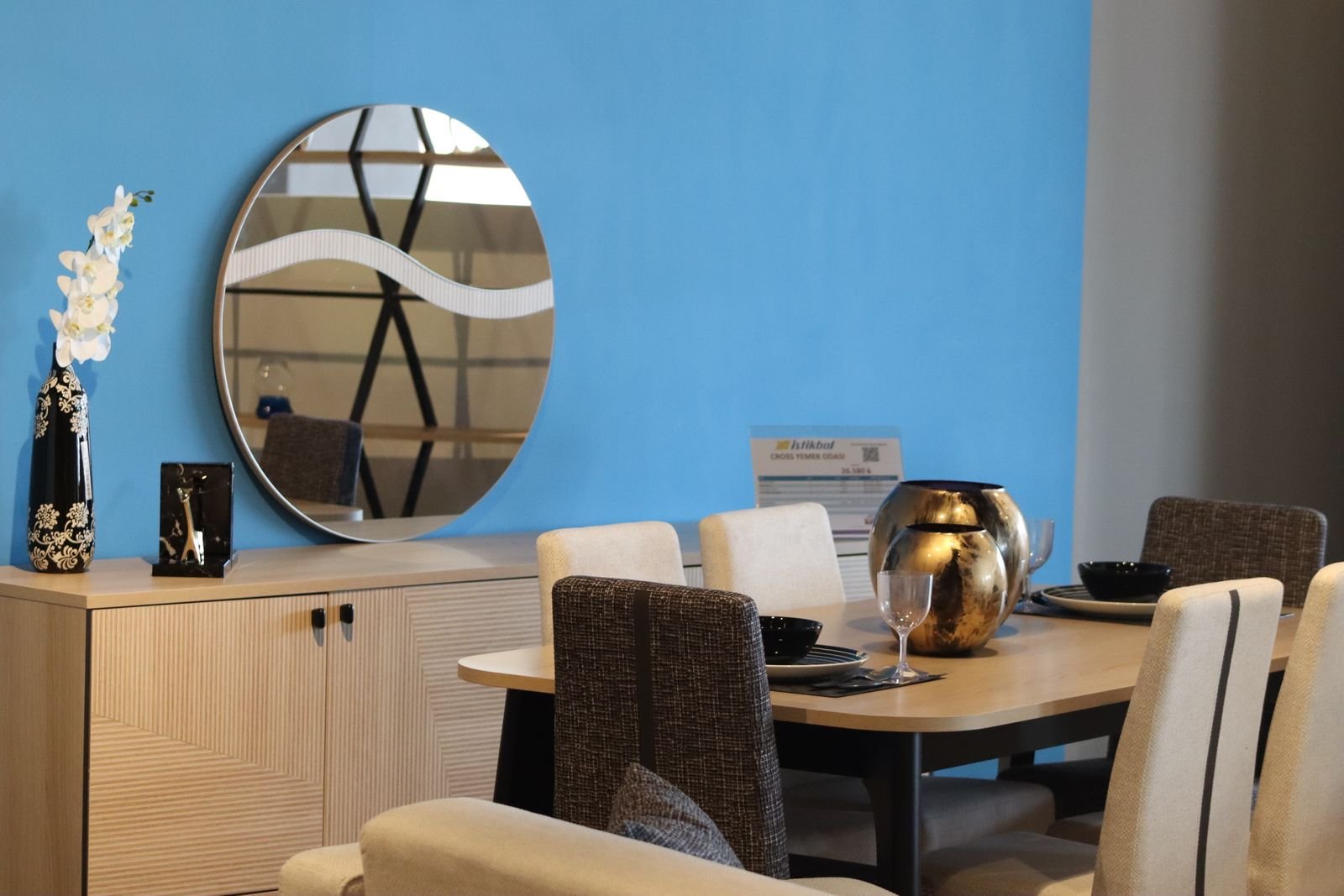
The round mirror is having its moment for good reason: a circle softens all the rectangles in a dining room (table, sideboard, windows) and feels instantly modern. A 30–40-inch diameter round mirror over a sideboard or console is the sweet spot — big enough to matter, small enough to hang with one sturdy hook.
Match the frame to your hardware: brass frame with brass chandelier, black frame with black chairs. Thin metal frames (brass, matte black, brushed nickel) run $60–$150 at mass retailers, and they’re light enough that a single heavy-duty anchor usually does the job. For extra polish, flank the mirror with two small wall sconces — the reflections of the flames or bulbs triple your ambient light.
Try it: Hang the mirror so its center sits at about 57–60 inches from the floor, the standard gallery eye level. That height looks right whether you’re standing or seated.
4. Arched Dining Room Mirror for Soft Architecture
An arched mirror borrows the elegance of arched windows and doorways — it’s my favorite way to add architectural interest to a flat, boxy wall. The arch shape feels traditional and modern at once, which is why it works in farmhouse, transitional, and even minimalist rooms.
Look for a 24–36-inch wide arch, hung so the curve’s peak lands around 66–72 inches off the floor. Wood or black metal arches run $100–$220; a full-length arched leaning mirror (65+ inches tall) runs $150–$300 and needs no hardware at all. The vertical shape also draws the eye upward, making standard 8-foot ceilings feel a touch taller.
Try it: Pair the arch with a runner rug in the same color family on the floor below — the echo between vertical mirror and horizontal rug makes the arrangement feel intentional.
Space-Boosting Dining Room Mirror Ideas for Small Dining Rooms
Small dining rooms benefit most from mirrors. These ideas focus on multiplying square footage — every one of them makes the walls feel farther apart than they are.
5. Full-Length Leaning Dining Room Mirror
Leaning a full-length mirror (60–72 inches tall) against the wall beside or behind the dining table creates the strongest “double the room” illusion of any single piece. Because it’s tall and reflective from floor to near-ceiling, it reads like a doorway into more space.
Place it at a slight angle — about 5–10 degrees — and secure the top to the wall with an anti-tip strap or picture-hanging wire so it can’t slide. Never lean a mirror where chairs or kids push against it. Prices run $100–$280 for a decent 24×72-inch piece with a real wood or metal frame, and it’s fully renter-friendly since there’s nothing to drill.
Try it: Angle the leaning mirror to reflect your window or chandelier, not the kitchen clutter. What it reflects matters more than the mirror itself.
6. Dining Room Mirror Gallery Wall
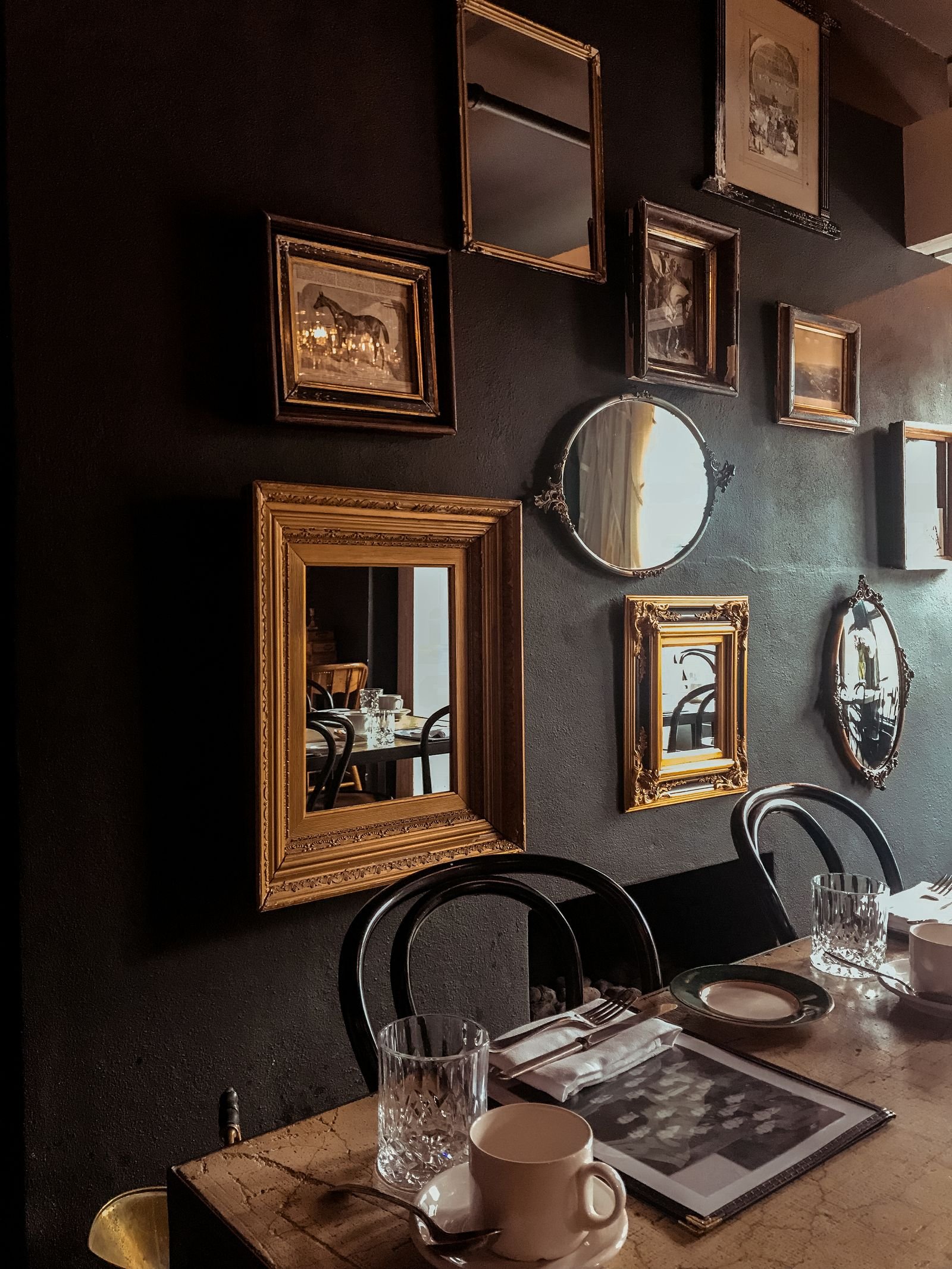
Who says a gallery wall needs paintings? Grouping 5–9 small mirrors in varied shapes — circles, hexagons, arches, ovals — bounces light in multiple directions and fills a blank wall with interest. The trick is a unifying element: keep all the frames in one finish (aged brass, black, or natural wood) while varying the shapes.
Map the arrangement on the floor first, then transfer it to the wall with painter’s tape. Leave 2–4 inches between pieces, and keep the whole cluster’s center around eye level (57–60 inches). Thrift stores and discount shops make this cheap — small decorative mirrors run $5–$15 each, so a full gallery wall often totals under $75. Use small picture hooks or even high-quality adhesive strips for the lighter ones.
Try it: Mix in two or three small framed prints or plates among the mirrors. The flat art keeps the wall from feeling like a funhouse.
7. Floor-to-Ceiling Mirror Panels in the Dining Room
This is the boldest move on the list: mirror panels covering one wall from floor to ceiling, essentially erasing the wall. It’s the single most effective trick for a narrow dining room, and it turns your table into a gallery piece — reflected from both sides.
You have two routes. The custom route uses frameless mirror panels cut to fit ($200–$400 for a 4-foot-wide section, professionally installed). The budget route uses framed IKEA-style mirrors lined up edge-to-edge, which achieves 80% of the effect for a fraction of the cost. Either way, choose a wall that reflects something worth doubling — the table and a chandelier, ideally — never a wall of clutter or the inside of an open closet.
Try it: Add one trailing plant or a single art print on the adjacent wall. One organic element keeps the mirrored wall from feeling cold.
Style-Forward Dining Room Mirror Ideas
These mirror ideas lead with style — statement shapes and finishes that act as the room’s jewelry while still doing the practical light work.
8. Sunburst Dining Room Mirror Over the Table
A sunburst mirror reads as sculpture first and mirror second, which makes it perfect above a dining table where you want drama without bulk. The radiating rays catch light from every angle, so even a 24–30-inch sunburst throws sparkle across the room.
Wood-and-gold sunbursts suit boho and mid-century rooms; polished-metal rays suit glam and modern ones. Hang it centered over the table, bottom edge at least 30 inches above the tabletop so diners never feel crowded. Quality pieces run $50–$140, and they’re light enough for a single anchor.
Try it: Point the sunburst at your chandelier. The rays fragment the reflected light into a starburst pattern that looks expensive at any price.
9. Backlit LED Dining Room Mirror for Evening Glow
A backlit mirror hides an LED strip behind the frame so a soft halo of light spills onto the wall around it. It’s the mirror version of candlelight — perfect for evening dining when overhead lights feel harsh.
Look for mirrors with warm-white LEDs (2700–3000K) rather than cool daylight tones; cool light over a dining table feels clinical. Most backlit mirrors plug into a standard outlet with a cord you hide behind a console, though hardwired versions exist if you’re renovating. Expect $120–$300 for a 30–36-inch round backlit piece. Check the switch location before buying — a touch sensor on the glass is far more practical than a cord switch behind furniture.
Try it: Put the mirror on a smart plug. “Dinner mode” becomes one tap: overheads dim, mirror glow on, chandelier low.
10. Venetian Etched Dining Room Mirror
A Venetian mirror — with hand-etched glass borders, beveled edges, and floral or scroll engraving — brings old-world European polish to a dining room. It’s the mirror equivalent of heirloom china: ornate, unapologetic, and gorgeous in traditional and glam spaces.
Real hand-etched Venetian mirrors start around $250 and climb fast; quality machine-etched versions run $120–$220 and look convincing at dining distance. Hang one large piece (36+ inches) rather than several small ones — the etched detail needs scale to read. Keep the surrounding wall simple so the engraving gets the spotlight.
Try it: Use a Venetian mirror opposite a window. The etched border sparkles in daylight and the plain center gives a clean reflection.
11. Mirrored Dining Room Sideboard and Furniture Accents
Sometimes the best dining room mirror isn’t on the wall — it’s built into the furniture. A mirrored sideboard reflects the room from below, doubling chandeliers and centerpieces while hiding table linens inside. Mirrored tray tops, bar carts, and serving stands deliver the same shimmer in smaller doses.
Choose mirrored pieces with beveled edges and real wood backing — cheap foil-backed versions cloud and spot within a year. A mirrored console sideboard runs $250–$600; a mirrored bar cart runs $100–$220. One mirrored furniture piece per room is plenty — two starts to look like a funhouse, and every fingerprint shows.
Try it: Style the mirrored surface with tall, sculptural objects — vases, candlesticks, branches. Height looks dramatic doubled in the reflection.
Budget-Friendly Dining Room Mirror Ideas
Every idea in this section costs under $150 — most under $75. Mirrors are one of the few decor categories where budget versions look nearly identical to expensive ones once they’re on the wall.
12. Thrifted Mismatched Dining Room Mirror Cluster
My favorite budget move: collect 4–8 small mirrors from thrift stores and flea markets over a few weekends, spray-paint the frames one unifying color, and hang them as a cluster over a console or beside the table. Satin black or metallic gold spray paint erases a multitude of sins — ornate frames and plain ones look like a matched set after two coats.
Keep each mirror under $10 and the whole project under $60 including paint and hooks. Unify by finish, vary by shape and size, and arrange with the largest piece slightly off-center for a collected, not decorated, feel. This is also the most forgiving project for beginners: if one mirror looks wrong, swap it out in minutes.
Try it: Take a photo of your arrangement on the floor, then hang from the photo as a map. It beats holding mirrors up with tired arms.
13. Frameless Beveled Dining Room Mirror Strips
Frameless beveled-edge mirrors give a clean, modern, gallery look for very little money. Buy 12×12-inch or 12×36-inch beveled mirror tiles (about $4–$8 each) and mount them in a tight grid of four, six, or nine. The beveled edges catch light at each seam, so a $40 grid reads far more expensive than it is.
Mount on a painted or wallpapered accent wall for contrast — charcoal, deep green, or navy paint behind frameless mirrors looks striking. Use mirror adhesive or the included mounting tabs, and level obsessively: a 1/8-inch crooked tile is visible from across the room. Total project cost: $30–$80 for the tiles plus adhesive.
Try it: Try a single horizontal row of three 12×36-inch tiles above a sideboard. It’s minimalist, modern, and installs in under an hour.
14. Faux Window Dining Room Mirror
A faux window mirror — a mirror with muntin-style framing that looks like a paned window — fakes daylight and a view where you have neither. It’s the best idea for windowless or basement dining rooms, and for long interior walls that need “a view.”
Choose one with slim black or white framing to read as a window rather than a mirror. A 36×48-inch arched or rectangular window-pane mirror runs $90–$180. Hang it where a real window would logically go — opposite the room’s entrance, not behind the table — and the brain accepts the illusion surprisingly well.
Try it: Hang a curtain panel or two on either side of the faux window mirror. The fabric sells the window illusion completely.
15. Mirrored Tabletop Accents and Tray Styling
The smallest move on the list: mirrored trays, coasters, and centerpiece bases that bring reflection to the table itself. A mirrored tray under a candle cluster doubles the candlelight at dinner; mirrored coasters bounce light with every glass.
A 16-inch beveled mirrored tray runs $15–$30; a set of four mirrored coasters runs $12–$20. Style the tray with odd-numbered groupings — three candlesticks or a candle plus a small plant — and rotate it seasonally like any centerpiece. It’s the lowest-commitment way to test whether you like mirrors in your dining room before drilling a single hole.
Try it: Place a mirrored tray on your sideboard first, then on your dining table at the next dinner party. Notice where the light lands — that tells you where a wall mirror would shine.

Dining Room Mirror Placement Rules That Actually Matter
Before you hang anything, these are the measurements and rules I use on every mirror project. They separate mirrors that look intentional from mirrors that look accidental.
- Height: Center a wall-hung mirror at 57–65 inches from the floor to its middle — standard gallery eye level. Above a sideboard or buffet, leave a 4–6-inch gap between the furniture top and the frame’s bottom so the two pieces read as one.
- Width: The mirror should be one-half to three-quarters as wide as the furniture beneath it. Wider than the furniture looks top-heavy and accidental.
- Reflect with intention: Stand where you’ll sit and check what the mirror shows. Aim for the chandelier, a window, or a styled vignette — never a TV, a messy counter, or the back of someone’s chair. Design sources agree: a dining room mirror should reflect something pleasant, and 2Modern’s dining room mirror height guide confirms the 4–6-inch-above-furniture rule.
- Opposite the window wins: Placing a mirror on the wall opposite or adjacent to your main window doubles natural light. This is the single highest-impact placement for a dark dining room.
- Hardware: Anything over 20 pounds needs a stud or toggle anchors rated for the weight — JRL Interiors’ mirror selection guide notes that mirrors must hang low enough to relate to the furniture but large enough to be seen in properly. For leaning mirrors, always add an anti-tip strap at the top.
- Cleaning: Clean mirrors with a microfiber cloth and a vinegar-water mix or ammonia-free glass cleaner. Streaks show double in a mirror that’s lit for dinner.
Common Mistakes to Avoid With Dining Room Mirrors
- Hanging it too high. A mirror floating a foot above the sideboard looks lost and disconnected. Keep that 4–6-inch gap, and hang lower rather than higher in rooms where people sit.
- Going too small. A tiny mirror on a big empty wall reads as an afterthought. When in doubt, size up — the biggest sizing regret is always “too small,” never “too big.”
- Reflecting the wrong thing. Mirrors double whatever they face. A mirror that doubles a cluttered kitchen counter or a blank closet door multiplies problems, not beauty.
- Using two mirrored furniture pieces. One mirrored sideboard is glamorous; a mirrored sideboard plus a mirrored bar cart plus mirrored trays is a funhouse. Edit ruthlessly.
- Ignoring weight and hardware. Oversized mirrors are heavy. Cheap picture hooks bend, adhesives fail, and a falling 40-pound mirror is genuinely dangerous. Studs or rated anchors, always.
- Placing it in direct blinding sunlight. Opposite a window is great; catching a full blast of low western sun that blinds diners at 6 p.m. is not. Test at the hour you actually eat.
Dining Room Mirror Ideas at a Glance
| Category | Best Pick | Typical Cost | When to Use It |
|---|---|---|---|
| Classic focal point | Oversized rectangular framed mirror over the sideboard | $80–$200 | You want one polished anchor on the wall |
| Soft modern look | Round dining room mirror above the console | $60–$150 | Your room has lots of hard rectangles to soften |
| Small-space illusion | Full-length leaning dining room mirror | $100–$280 | Renter-friendly, zero drilling, maximum depth effect |
| Maximum drama | Floor-to-ceiling mirror panels | $200–$400+ | A narrow dining room that needs to disappear one wall |
| Statement art | Sunburst dining room mirror | $50–$140 | You want sculpture and sparkle over the table |
| Evening ambiance | Backlit LED dining room mirror | $120–$300 | Dinner parties and mood lighting without rewiring |
| Budget hero | Thrifted mismatched mirror cluster | Under $60 | A custom gallery look for almost nothing |
| Zero commitment | Mirrored tray and tabletop accents | $15–$30 | Test-drive the look before drilling holes |
Are Dining Room Mirrors Still in Style?
Yes, in my home they absolutely are, but the look has softened. I still reach for a mirror when a dining room feels dark or boxed in, because nothing else bounces light and opens up a wall quite like it. What has changed is the shape and the finish: I see far more organic, softly curved outlines, warm wood frames, and slim black or brushed-brass frames than I did a few years ago, and far fewer heavy, fussy frames that fight with the table.
The dated looks I would avoid now are mirrored wall tiles, a small mirror that gets lost above a long sideboard, and a very ornate gilt frame in an otherwise calm, modern room. If I want a classic feel, I keep the frame simple and let the size and the reflection do the work.
Dining Room Mirror Shapes at a Glance
I use this quick comparison when I am deciding between shapes, before I fall in love with a frame I cannot hang well.
| Shape | Typical width | Best table or wall | Price band |
|---|---|---|---|
| Rectangular | 24–48 inches | Long rectangular table or a sideboard wall | $60–$300 |
| Round | 24–36 inches | Round or small square table, or a wall between windows | $50–$250 |
| Arched | 24–36 inches | Sideboard wall or a tall, narrow wall | $80–$350 |
| Oval | 20–32 inches | Smaller table or a narrow wall | $50–$250 |
| Sunburst | 24–36 inches | Plain wall above a sideboard, as a statement piece | $70–$300 |
My Quick Do-and-Don’t Checklist
- Do hang the mirror so it reflects a window, a plant, or a pretty wall, not clutter.
- Do keep it in proportion to the table or sideboard below it, with space to breathe on each side.
- Do check the reflection from your seat before you drill any holes.
- Do use a proper wall anchor for a heavy frame, especially on plasterboard.
- Don’t hang a mirror so high that you only see the ceiling in it.
- Don’t let it compete with a bold light fitting or a busy gallery wall.
- Don’t put a tiny mirror above a long sideboard and expect it to anchor the wall.
A Few More Questions I Get Asked
Should I choose one statement mirror or a matching set?
I usually start with one statement mirror, especially over a sideboard or a long table, because it gives the room a clear focal point. A matching set or a pair works best when I want symmetry, for example one mirror on each side of a sideboard or flanking a window, but I keep the frames identical and the spacing even so the pair reads as one calm idea rather than two competing pieces.
How do I pair a mirror with a sideboard?
I treat the sideboard and the mirror as one arrangement. I choose a mirror a little narrower than the sideboard, hang it just above it with a small gap, and keep the top of the sideboard fairly clear so a lamp or a vase does not block the glass. If the sideboard is already busy, I go simpler with the frame.
What lighting works best with a dining room mirror?
I like soft, warm light for a dining mirror: a pair of sconces on either side, a pendant that does not glare straight into the glass, or candles and a dimmer for the evening. I avoid a single harsh overhead light facing the mirror, because it creates glare and doubles an unflattering reflection instead of a warm glow.
Dining Room Mirror FAQ
Should you put a dining room mirror in your dining room?
Yes — a mirror is one of the highest-impact, lowest-cost upgrades for the space. It doubles natural and candlelight, makes small dining rooms feel larger, and adds a finished layer that art alone can’t. Just be deliberate about what it reflects: aim for a window, chandelier, or styled wall, never clutter.
How high should a dining room mirror be hung?
Center a standalone mirror at 57–65 inches from the floor to its middle — standard gallery eye level. When hanging above a sideboard or buffet, leave a 4–6-inch gap between the furniture top and the bottom of the frame, and make sure the mirror is one-half to three-quarters as wide as the furniture below.
What size dining room mirror works best over a sideboard?
For a standard 48–60-inch sideboard, a 30–44-inch wide mirror hits the sweet spot. Round mirrors of 30–40 inches in diameter work beautifully; rectangular mirrors of 36×48 inches or similar are the classic choice. The guiding rule: the mirror should span roughly two-thirds of the sideboard’s width.
Is it bad to put a mirror facing the dining table?
It’s not bad at all — a mirror opposite or behind the table is a classic placement that doubles the table setting and candlelight. The one caution from feng shui tradition is avoiding a mirror that reflects diners’ backs in an uncomfortable way; most designers simply recommend checking that the reflection shows something pleasant.
Can a mirror make a small dining room look bigger?
Absolutely — this is the mirror’s superpower. A full-length leaning mirror or mirror panels on one wall extend the sight line past the wall, making the room read as nearly twice its size. For maximum effect, position the mirror to reflect a window or your chandelier, so you’re doubling light as well as space.
What’s the best dining room mirror frame for a modern room?
Thin-framed or frameless round and arched mirrors in matte black, brushed brass, or polished nickel suit modern dining rooms best. Avoid heavy ornate gilding in a minimalist room — it fights the aesthetic. A frameless beveled-edge mirror gives the cleanest modern look and is often the cheapest option too.
How do you safely hang a heavy dining room mirror?
Find at least one wall stud and use it, or use toggle bolts rated for at least twice the mirror’s weight. Hang from two points (D-rings or wire) rather than one for stability. For leaning mirrors, add an anti-tip strap anchoring the top to the wall. Never rely on adhesive strips or small nails for anything over 20 pounds.
Are antique mirrors a good idea?
They’re a wonderful idea if the glass is sound. Antique gilded and Venetian mirrors bring character that new pieces can’t replicate, and minor foxing or tarnish adds to the charm. Inspect the backing and check the glass doesn’t rattle in the frame before buying — loose glass means the seal has failed and the mirror may keep deteriorating.
Final Thoughts
A mirror does more work per dollar than almost any other decor purchase I know. Whether you go big with an oversized framed piece over the sideboard, get thrifty with a spray-painted mirror cluster, or fake a window where you have none, the payoff is the same: more light, more depth, and a dining room that feels finished.
Start with the placement rules — right height, right width, reflect something beautiful — and pick the idea that fits your style and budget. Then step back and watch your room double. Which one are you hanging first?

Founder of NestFlavors — sharing tested recipes and honest home ideas, made for real life.