
A bare wall above the sofa is the loudest thing in a lounge room.
I lived with one for a year. The sofa was right, the rug was right, and the room still felt unfinished every time I walked in. One large framed print fixed it in an afternoon — suddenly the whole room had a focal point, and everything else fell into place around it.
That is what good lounge room wall art does. It sets the mood, anchors the furniture, and tells guests what kind of room they are in before they sit down. Here are 15 ideas that work in real rooms, with the sizing rules that keep art from looking too small, too high, or lost on a big wall.

What Is Lounge Room Wall Art?
Lounge room wall art is any artwork, print, photograph, mirror, or wall hanging displayed in the main sitting room of a home — the room where you relax, host friends, and spend most evenings. It includes framed canvas prints, gallery walls, tapestries, metal pieces, and sculptural wall decor.
The key difference from art in other rooms is scale. Lounge walls are usually the largest in the house, and the art has to hold its own against a sofa, a TV, and a full seating area. That is why sizing and placement matter as much as the art itself.
Why You’ll Love These Lounge Room Wall Art Picks
- Instant focal point. One strong piece above the sofa gives the whole room a center, so the rest of the decor stops competing for attention.
- Personality without a remodel. Art changes the mood of a room faster and cheaper than new furniture or paint.
- Works in rentals. Leaning frames, picture ledges, and adhesive hooks mean you can hang art without losing your deposit.
- Easy to refresh. Swap one print or rotate a gallery wall and the room feels new again, with no tools required.
- Something for every budget. Printable art, thrifted frames, and one good canvas cover every price range on this list.
Lounge Room Wall Art Above the Sofa
The sofa wall is the first wall guests see, and it is where sizing mistakes show up most. These five ideas get it right.
1. One Oversized Canvas Print
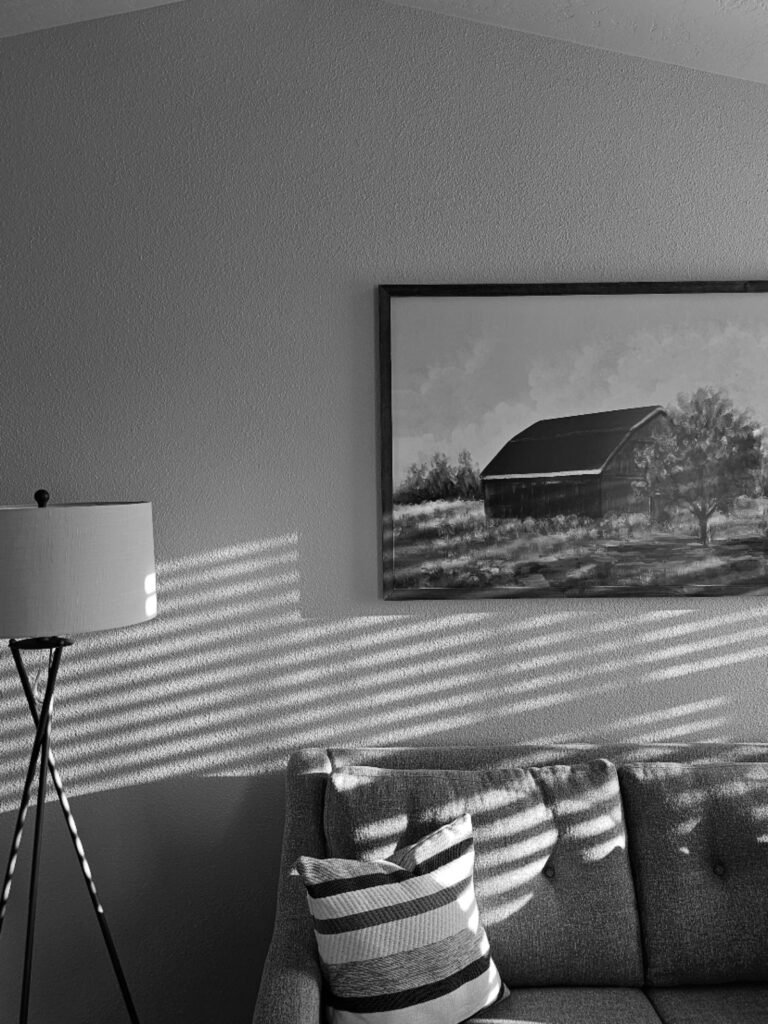
One large canvas beats a cluster of small frames on a wide sofa wall, because a single bold image reads from across the room. Aim for art about two-thirds the width of the sofa, hung with its bottom edge roughly a hand’s width above the sofa back. Abstract landscapes and soft color washes suit rooms where the furniture already has strong patterns.
Try it: Tape a paper template the size of the canvas on the wall first and sit on the sofa to check the view.
2. A Triptych in Three Matching Panels
A triptych — one image split across three panels — fills a long wall without the fuss of arranging different frames. Keep the gaps between panels even, about two to three inches, so the set reads as one piece. Nature scenes and calm abstract gradients work well here because they do not fight with the cushions.
Try it: Hang the middle panel first, centered on the sofa, then measure outward for the two side panels.
3. A Pair of Matching Prints
Two identical-size prints hung side by side bring instant symmetry to a sofa wall, which suits formal rooms and matching armchairs. Botanical prints, line drawings, and black-and-white photography all work in pairs. Keep the frames identical and the images in the same color family, or the pair will look like two strangers.
Try it: Use one frame style in a different finish — black frames on a light wall, wood frames on a dark wall — for contrast.
4. A Leaning Statement Piece
Leaning a large framed piece on a console or mantel behind the sofa skips drilling entirely, which renters love. The frame needs a sturdy base and a wall to lean against, and it should be tall enough that its top clears the sofa back by a good margin. This look suits casual rooms where a slightly undone feel is part of the charm.
Try it: Add a small museum putty pad behind the top corners so the frame never slides forward.
5. A Framed Textile or Tapestry
A woven textile adds warmth and texture that flat prints cannot, and it softens a room full of hard surfaces like leather and glass. Hang it from a slim wooden rod or frame it behind glass if you want a cleaner look. Natural fibers and muted patterns suit calm rooms, while bold woven geometrics wake up a neutral sofa.
Try it: Steam or iron the textile before hanging — wrinkles show more on a wall than they ever do folded away.
Lounge Room Wall Art for Gallery Walls and Small Spaces
Gallery walls are the best fix for small or awkward walls, because you build the display around the space instead of hunting for one perfect piece.
6. A Classic Gallery Wall
A gallery wall mixes framed prints, photos, and small objects into one collection, and it is the fastest way to make a lounge feel personal. Start with the largest piece slightly off-center, then build outward with even gaps. Mixing frame styles works if you keep one thread — all wood, all black, or all gold — running through the set.
Try it: Lay the whole arrangement on the floor first, photograph it, and only then start hanging.
7. A Grid Gallery in Matching Frames
A strict grid of identical frames feels calm and orderly, which suits modern lounges and hallway-style walls. Black-and-white photos or simple line art look sharp in a grid, because the repetition is the design. Measure twice here — a grid only looks good when the spacing is exact.
Try it: Use a laser level or a long spirit level for the top row, then measure down from it for every row below.
8. A Picture Ledge for Rotating Art
A picture ledge is a narrow shelf that holds framed art upright, so you can swap pieces with the seasons and never drill a new hole. I rotate mine every few months, and the room feels refreshed for free. Ledges also suit renters, since one shelf means far fewer wall holes than a full gallery wall.
Try it: Layer a small frame in front of a large one for depth, and add one tiny plant or vase at the end.
9. Small Art on a Narrow Wall
Narrow walls between windows or beside a fireplace suit one small vertical piece or a stack of two, not a wide print that crowds the edges. Leave breathing room around the frame — art crammed edge to edge looks accidental. A slim vertical landscape or a tall botanical print fits these spots well.
Try it: Center small art at eye level, about 57 to 60 inches from the floor to the middle of the piece.
10. Art in an Awkward Corner
Corners often sit empty because a flat frame cannot wrap around them. Hang two small matching pieces, one on each wall meeting at the corner, and the corner becomes a feature instead of a dead zone. Keep both pieces at the same height so they read as a pair.
Try it: Use the same frame and subject family on both walls — two botanicals, two travel photos, two abstracts.
Lounge Room Wall Art With Mirrors, Texture, and Light
Not every wall piece needs to be a print. Mirrors, texture, and light change how a room feels in ways flat art cannot.
11. A Large Mirror as Wall Art
A large mirror doubles light and makes a small lounge feel wider, and a decorative frame turns it into art in its own right. Hang it across from a window to bounce daylight into the room, or above a console where a print would sit. Round mirrors soften rooms full of rectangles; arched mirrors suit tall, narrow walls.
Try it: Check what the mirror reflects before you hang it — a blank ceiling or a messy corner is not a view worth doubling.
12. Woven and Macramé Wall Hangings
Woven hangings add softness and texture to rooms that feel cold, especially those with leather sofas and hard floors. They are light, easy to hang with a single hook, and simple to swap. Keep them away from direct sun and kitchen grease, which fade and stain natural fibers over time.
Try it: Pair a woven hanging with one framed print beside it, so the wall has both texture and a crisp edge.
13. Metal and Wood Wall Sculptures
A metal sunburst, a carved wood panel, or a set of wooden wall discs adds dimension that flat art cannot, because shadows shift across it through the day. These pieces suit rooms where the walls are already a strong color, since the sculpture stands out against them. Check the weight and use the right wall anchor — a heavy wood panel needs a stud, not a small nail.
Try it: Light a sculpture with a picture light or a nearby lamp so its texture shows in the evening too.
14. Art Lit With Picture Lights
A picture light above a favorite piece makes it look gallery-worthy and gives the lounge a warm evening glow. Battery-powered picture lights now make this easy with no wiring, and they are a smart pick for renters. Keep the light warm-toned to match lamps, so the art does not glow cold blue in a cozy room.
Try it: Mount the light so it washes down the face of the art, not straight out into the room.

15. Seasonal Art Swaps
Swapping one or two pieces with the seasons keeps a lounge feeling fresh without redecorating. I keep a light botanical print for spring and summer and a moodier landscape for autumn and winter, and the swap takes ten minutes. Picture ledges and leaning frames make swaps effortless, since nothing needs rehanging.
Try it: Store off-season art flat, wrapped in tissue, in a dry spot so frames and prints stay in good shape.
How to Pick Lounge Room Wall Art for Your Room
Choosing lounge room wall art gets easier when you start from the room, not from a print you liked online. Look at your sofa color, your rug, and the light at the time of day you actually use the room. A piece that glows in a bright showroom can vanish in a north-facing lounge, and a dark, moody print can overwhelm a small room that already runs dark.
Color is the simplest thread to follow. Pull one color from your rug or cushions into the art, and let the rest of the piece add contrast around it. That shared color is what makes a room feel designed instead of assembled. If your room is mostly neutral, art is the safest place to add a bold color, because a print is far easier to swap than a sofa.
Size comes next, and it matters more than subject. Measure the wall section the art will sit on, then shop with that width in mind — not the other way around. Lounge room wall art that spans about two-thirds of the furniture beneath it looks intentional, while a piece that covers only a third of the sofa looks like an afterthought, no matter how beautiful the image is.
Frames deserve a thought too, since they are part of the look. Slim black frames suit modern rooms and photography, warm wood frames suit traditional rooms and landscapes, and gold frames suit formal rooms and classic art. Keep the frame style consistent across a wall, even when the subjects differ, and the whole display will read as one collection.
Budget is the last piece, and lounge room wall art covers every range honestly. Printable art in a good frame looks sharp, thrifted frames with new mats rescue old prints, and one well-chosen canvas anchors a room better than five cheap pieces that never quite work. Spend the most on the sofa wall, since that is the wall everyone sees, and save the smaller walls for experiments.
- Start from the room’s colors and light, not from a single print you liked online.
- Measure the wall section first, then shop for art that fits it.
- Keep one frame thread across each wall so mixed subjects still read as a collection.
- Put your budget on the sofa wall, where the art does the most work.
One last check before you hang anything: step back to the doorway and look at the wall the way a guest would on arrival. The best lounge room wall art reads clearly from that distance and rewards a closer look once you sit down. If it only works from two feet away, it belongs in a hallway, not over your sofa.
Common Mistakes to Avoid
- Hanging art too high. The classic error is centering art on the wall instead of relating it to the furniture. Art above a sofa should sit close to the sofa back, with its center near eye level when you are standing.
- Going too small. A tiny frame on a huge wall looks lost. When in doubt, go one size up, or build a gallery grouping to fill the space.
- Ignoring the furniture below. Art should relate to what sits under it — about two-thirds the width of the sofa or console beneath it. Floating art with no anchor looks random.
- Mixing too many styles at once. A gallery wall can mix subjects, but mixing five frame styles, three color palettes, and two themes turns a collection into clutter. Pick one thread and stick to it.
- Forgetting lighting. A beautiful print in a dark corner reads as a dark rectangle. A nearby lamp or picture light changes everything in the evening.
- Using weak hangers for heavy pieces. Large mirrors and wood sculptures need studs or rated wall anchors. A fallen frame damages the wall, the floor, and the art.
Lounge Room Wall Art at a Glance
| Idea | Best For | Sizing Rule | Watch Out For |
|---|---|---|---|
| Oversized canvas | Wide sofa walls | Two-thirds of sofa width | Hanging too high |
| Triptych | Long walls | Even 2–3 inch gaps | Uneven panel spacing |
| Gallery wall | Personal collections | Center at eye level | Too many frame styles |
| Picture ledge | Renters, rotations | One level shelf | Overloading the ledge |
| Large mirror | Small, dark rooms | Across from a window | Reflecting a bad view |
| Picture lights | Favorite pieces | Light washes down the art | Cold-toned bulbs |
For more gallery inspiration, see Architectural Digest’s gallery wall ideas for layouts and styling tips.
FAQ
How big should lounge room wall art be above a sofa?
Aim for art about two-thirds the width of the sofa, hung with its bottom edge roughly six to ten inches above the sofa back. A piece much smaller than that looks lost, while one wider than the sofa overwhelms it. If you cannot find one piece at that size, a gallery grouping of the same total width works just as well.
How high should I hang art in a lounge room?
Hang the center of the piece at eye level, about 57 to 60 inches from the floor, when it stands alone on a wall. Above furniture, hang it six to ten inches above the furniture instead, so the art and the furniture read as one group. In rooms with very tall ceilings, stay with eye level — art should relate to people, not to the ceiling.
Can I mix different frame styles in a gallery wall?
Yes, if you keep one thread running through the set: all wood frames, all black frames, or all gold frames. Mixing subjects is fine, and mixing frame colors works when the frames share a material or finish family. Without that thread, the wall reads as random instead of collected.
What kind of wall art suits a small lounge room?
Large mirrors and one oversized piece work better than many small frames, because they open the room up instead of chopping the wall into pieces. Light colors and simple subjects keep a small room feeling airy. If you love a gallery wall, keep the frames slim and the palette light.
Is a mirror a good substitute for wall art?
Yes, especially in small or dark lounges, where a mirror adds light and a sense of space that a print cannot. Pick a mirror with a decorative frame so it reads as a design piece, not just a utility mirror. Hang it where it reflects something worth seeing, like a window or a plant.
How do I hang art without damaging rental walls?
Use adhesive strips rated for the frame’s weight, lean large frames on furniture, or mount a single picture ledge that needs only two small holes. Always check the weight rating and the wall surface first — adhesive strips fail on textured walls and in humid rooms. Remove them slowly, following the maker’s directions, to protect the paint.
Should wall art match the sofa or the rug?
It should relate to the room, not match one piece exactly. Pick up one color from the rug or cushions and repeat it in the art, while letting other colors in the piece add contrast. Exact matching looks flat; a shared color thread looks intentional.
How often should I change lounge room wall art?
There is no rule, but a seasonal swap of one or two pieces keeps the room feeling fresh without a full redecoration. Picture ledges make swaps easy, since you lift one frame off and set another down. Keep your favorite anchor piece in place and rotate the smaller pieces around it.
Final Thoughts
The right lounge room wall art does not need to be expensive or rare — it needs to be the right size, at the right height, and in colors that belong in your room. Start with the sofa wall, get that one piece right, and the rest of the room will start making sense around it.
Tape up a template, check it from the sofa, and hang with confidence. A finished wall changes how the whole lounge feels, every single evening.
Also Read:

Founder of NestFlavors — sharing tested recipes and honest home ideas, made for real life.