
A dining room without storage is a dining room where the good dishes live in a box in the garage. Here’s how to fix that.
I’ve helped friends pick out dining cabinets for everything from a 90-square-foot studio nook to a full formal dining room, and the same truth shows up every time: the right cabinet makes the room work twice as hard. It holds the plates, hides the clutter, anchors the wall, and gives you a surface for the lamp, the art, and the Friday-night wine glasses. Get the size or type wrong, though, and it becomes an expensive obstacle you walk around for years.
This guide covers the 15 best dining room cabinet ideas — every major type, every style worth your money, real dimensions in inches, what actually fits inside, the materials that last, styling rules that work, and the mistakes I see people make over and over. Let’s find yours.
Quick Answer: What Is a Dining Room Cabinet?
A dining room cabinet is a freestanding storage cabinet — a buffet, sideboard, hutch, or credenza — placed in or near the dining room to hold tableware, serving pieces, and linens. Most measure 48–72″ wide, 30–36″ tall, and 16–20″ deep. Choose one 60–75% as long as your dining table, leave 30″+ clearance in front, and prioritize adjustable shelves so real dinnerware actually fits inside.

What Is a Dining Room Cabinet?
A dining room cabinet is a storage and display cabinet placed in or near the dining room, designed to hold tableware, linens, and serving pieces while giving the room a finished, anchored look. It can take many forms — a low buffet, a long sideboard, a two-piece hutch, a sleek credenza, or a tall display cabinet — but every version does the same two jobs: keep dining essentials close at hand and make the wall behind it look intentional.
Retailers use “dining room cabinet,” “sideboard,” “buffet,” and “credenza” almost interchangeably, which is exactly why shopping for one feels confusing. The labels matter less than the measurements and the interior layout — a 60-inch-wide cabinet with adjustable shelves works the same whether the tag says buffet or sideboard. Focus on dimensions, door style, and storage layout, and you’ll buy right no matter what the product title calls it.
Why You’ll Love a Dining Room Cabinet
- It ends the tableware shuffle. Dinner plates, serving bowls, placemats, and the good wine glasses get a real home — no more digging through kitchen cabinets mid-dinner-party.
- It doubles as a serving station. A sturdy 30-to-36-inch-high top is the perfect height for laying out a buffet spread, setting up a coffee bar, or parking the dessert tray.
- It anchors the room visually. A long, low cabinet grounds the wall the same way a rug grounds the floor. Bare dining room walls stop looking unfinished the day the cabinet arrives.
- It hides the ugly stuff. Table linens, chargers, candle collections, board games, even the Wi-Fi router — closed doors make clutter disappear in seconds.
- It works in rentals and small homes. Slim, floating, and freestanding options give you full storage without built-ins, drilling, or landlord negotiations.

Classic Dining Room Cabinet Types
These are the five foundational shapes of the dining room cabinet world. Once you know which type fits your room and your habits, everything else — style, material, finish — becomes an easy yes-or-no decision.
1. The Buffet: The Dining Room Workhorse
The buffet is the classic choice: long, relatively low, with drawers and cabinets below and a generous top surface for serving. Most buffets run 48 to 72 inches wide, 30 to 36 inches tall, and 16 to 20 inches deep — dimensions that evolved specifically around dinner service.
Inside a good buffet you’ll find a mix that matches how people actually entertain: shallow drawers up top for flatware, napkins, and serving utensils, and deeper cabinets below for stacks of plates, platters, and tablecloths. If you host Thanksgiving, holiday dinners, or even regular family gatherings, the buffet is the piece that earns its floor space — it holds the overflow and serves as the staging area when the table is full.
Look for one with adjustable shelves so tall pitchers and punch bowls fit without wasting vertical space. A buffet with a hutch (an upper display section with glass doors) doubles your storage and turns your grandmother’s china into decor.
Try it: Measure your dining table, then aim for a buffet that’s 60 to 75 percent of the table’s length — a 72-inch table pairs beautifully with a 48-to-54-inch buffet.
2. The Sideboard: Low, Long & Versatile
Sideboards and buffets are cousins — some furniture makers use the names interchangeably, and honestly, the distinction is soft. The going consensus: a sideboard sits lower to the floor with short legs or no legs at all, while buffets tend to have taller legs. In practice, a sideboard in the dining room and a buffet are often the exact same piece of furniture.
What makes the sideboard worth knowing by name is its flexibility. It’s the most room-agnostic storage piece you can buy. Use it in the dining room for dishes and linens, move it to the living room as a media console, or park it in the entryway for keys, mail, and shoes. That grounded, substantial posture looks architectural rather than fussy, which is why sideboards work in modern, Scandinavian, and eclectic rooms alike.
Try it: If your home is open-concept or you rearrange furniture often, buy the sideboard over the buffet — its minimal profile adapts to every room.
3. The Hutch: The Two-Piece Showpiece
A hutch is a two-piece cabinet: a base cabinet with drawers and storage below, topped by an upper section with open shelves or glass-front doors for display. It’s the tallest option on this list and the most traditional — the piece your grandmother’s dining room was built around.
The hutch does two jobs at once: hidden storage down low, curated display up high. Use the upper shelves for the pretty stuff — wedding china, collected ceramics, a row of matching glassware — and the base for everything practical. Because hutches are tall (often 72 to 84 inches), they need a wall with real presence and at least 8-foot ceilings to avoid looking cramped.
Try it: Keep the displayed items to one color family or material (all white ceramics, all amber glass) — a hutch looks collected and calm instead of cluttered.
4. The Credenza: Sleek & Modern
The credenza is the minimalist’s pick: low, long, and composed, usually sitting on short legs with clean lines and minimal ornament. Storage hides behind slab or sliding doors, and the emphasis is on a calm horizontal line rather than display.
Credenzas shine in modern, contemporary, and Japandi dining rooms, and they’re the best choice when you want storage that doesn’t visually shout. The low profile keeps small rooms feeling open, and the long top surface is ideal under a large piece of art. Just check the interior before you buy — some credenzas prioritize looks over usable shelf depth, and your dinner plates need at least 12 inches of clear interior depth.
Try it: Pair a credenza with one oversized piece of art hung 6 to 8 inches above it — the combination reads as one designed moment.
5. The Corner Cabinet: The Dead-Space Saver
Corner cabinets exist for the wall angle everyone ignores. A triangular or L-shaped dining room cabinet tucks into the corner, turning dead space into storage for the items you use least often — holiday platters, the fondue set, vases, backup linens.
Most corner cabinets are taller than they are wide (think 24 to 36 inches wide, 60 to 72 inches tall), often with glass doors on the upper section. They’re especially good in square dining rooms where a full-length buffet would crowd the table. The trade-off is access: deep corner interiors swallow things, so use bins or turntables inside to keep the back reachable.
Try it: Use a corner cabinet as your “occasion” storage — everything for holidays and dinner parties lives there, and everyday items stay in the kitchen.
Dining Room Cabinet Styles That Never Miss
Type is about shape; style is about personality. These five finishes and aesthetics show up in well-designed dining rooms year after year because they coordinate with real furniture instead of fighting it.
6. Modern Minimalist Cabinet
Flat-panel doors, no visible hardware (push-to-open or slim bar pulls), and a matte finish in white, black, or warm gray. The modern minimalist dining room cabinet disappears into the wall in the best way — all storage, no visual noise.
This style works hardest in small and open-concept dining areas, where every piece of furniture competes for visual calm. Choose engineered wood or MDF with a matte lacquer for a finish that wipes clean and resists fingerprints better than high-gloss. Keep the top styling minimal too: one sculptural object, one stack of books, done.
Try it: If your dining chairs are upholstered or your table is rustic wood, a minimalist cabinet balances the room instead of matching it — contrast beats matchy-matchy.
7. Farmhouse Buffet Cabinet
Distressed finishes, beadboard paneling, barn-door-inspired sliders, turned legs, and warm wood tones. The farmhouse dining room cabinet brings cozy, collected character — and it’s forgiving, since the style expects a little wear.
Farmhouse buffets are usually engineered wood or pine with an antiqued finish, which keeps prices reasonable. The look pairs naturally with wood dining tables and works in both actual farmhouses and suburban dining rooms that want warmth. Watch the hardware: black iron pulls and cup handles sell the style, while shiny chrome fights it.
Try it: Style the top with a runner, a wooden tray, and a pitcher of greenery — farmhouse looks best with natural textures, not formal symmetry.
8. Mid-Century Modern Credenza
Tapered legs, warm walnut or teak tones, sliding doors, and those iconic long horizontal proportions. The mid-century modern dining room cabinet has been in style for seventy years, which tells you everything about its staying power.
Real vintage pieces are solid wood and built like tanks, but good reproductions in walnut veneer over engineered wood deliver the look at a fraction of the price. The style’s low profile (often 30 inches tall or less) suits rooms with large windows or wainscoting you don’t want to cover. Sliding doors are period-correct but limit access — you can only open one side at a time.
Try it: Let the wood be the star. Keep the top nearly bare — a single low bowl or a small plant — so the grain and legs read clearly.
9. Traditional Wood Cabinet
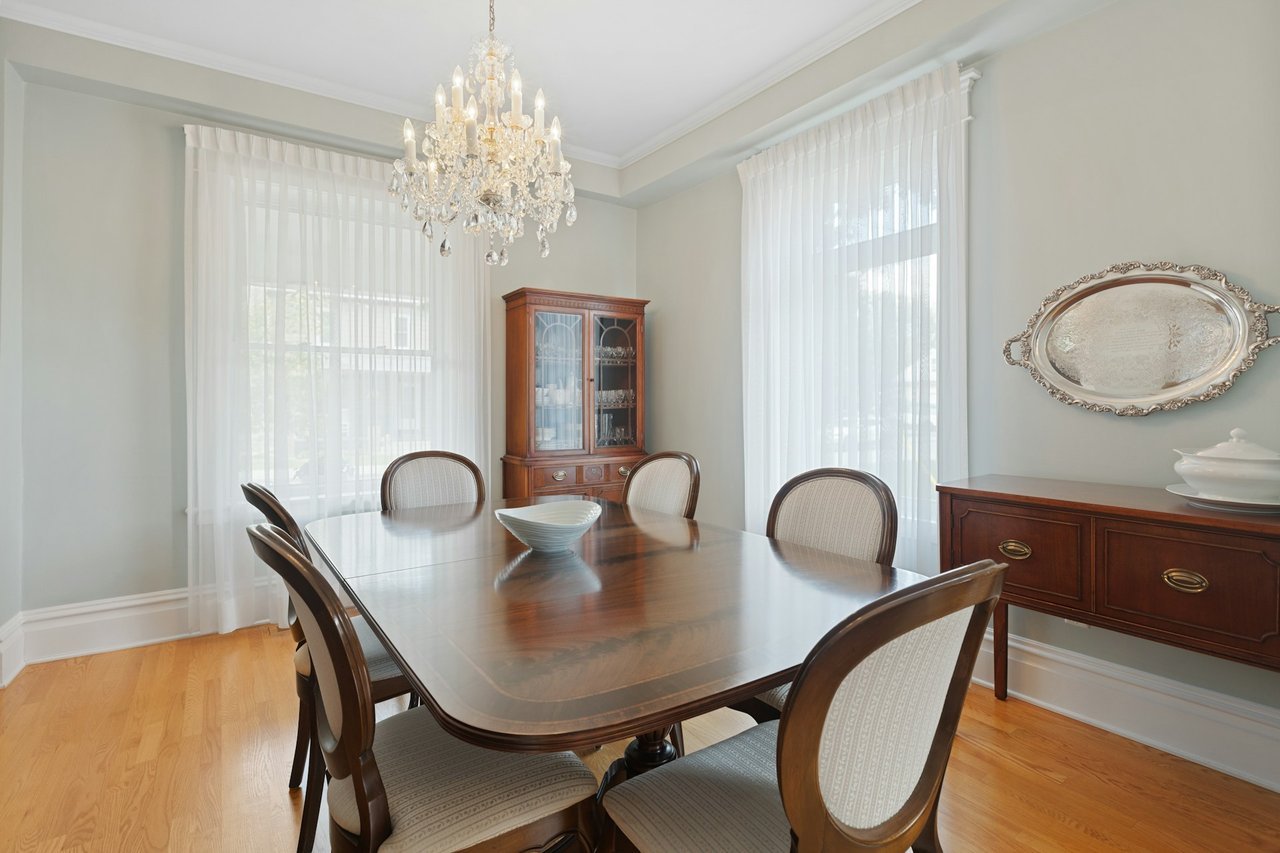
Raised-panel doors, crown molding, rich cherry or mahogany finishes, brass hardware. The traditional dining room cabinet is the formal option — substantial, symmetrical, and built to match classic dining sets.
This style makes the most sense in a dedicated formal dining room with a matching table and chairs. Quality matters more here than in any other style: solid wood or thick veneer over hardwood plywood will age gracefully, while thin photo-printed finishes look cheap next to real wood furniture. Expect traditional cabinets to run heavier and deeper (up to 20 to 22 inches), so confirm your clearance before ordering.
Try it: Flank a traditional cabinet with a matching pair of table lamps — symmetry is the whole point of this style.
10. Rattan & Cane-Front Cabinet
Woven rattan or cane door fronts with wood frames and brass or black hardware. The rattan dining room cabinet adds texture and airiness — the doors read as semi-transparent, so the piece feels lighter than a solid-door cabinet of the same size.
This is the style for coastal, boho, and warm-modern dining rooms. The weave hides minor wear beautifully, and the natural material warms up white or gray rooms instantly. Two things to know: rattan fronts collect dust in the weave (a soft brush attachment handles it), and they’re not fully opaque — store pretty things behind them, not the plastic containers.
Try it: If your dining room feels heavy or dark, a cane-front cabinet is the fastest visual lightener that still gives you closed storage.
Small-Space & Clever Dining Room Cabinets
No wall for a 72-inch buffet? These five ideas deliver real dining room storage in tight, awkward, or rental spaces.
11. The Slim Console Cabinet
A 12-to-14-inch-deep cabinet that hugs the wall. Slim consoles hold table linens, placemats, candles, and serving utensils — the flat stuff — while barely projecting into the room.
This is the answer for dining nooks, galley-style dining areas, and apartments where a standard 18-inch-deep cabinet would block chair movement. You give up plate storage (dinner plates need 12 inches of interior depth minimum, which leaves almost nothing for door clearance), but you gain a landing surface and hidden storage where nothing fit before.
Try it: Place a slim console on the wall perpendicular to your table rather than behind it — it stays out of the chair zone entirely.
12. Wall-Mounted Display Cabinet
A cabinet that hangs on the wall with zero floor footprint. Wall-mounted cabinets with glass doors typically run 24 to 48 inches wide and 12 to 16 inches deep — perfect for glassware, small plates, and the pretty things.
Mounting into studs matters; a loaded wall cabinet can weigh 80 to 100+ pounds, and drywall anchors alone won’t cut it. The payoff is huge in tiny dining areas: storage at eye level, floor space untouched, and glass doors that make everyday dishes look like a display. Renters, take note: this one usually requires drilling, so check your lease or look at item 15 instead.
Try it: Hang the cabinet so its bottom edge sits 54 to 60 inches from the floor — reachable shelves without blocking sightlines across the table.
13. The Floating Shelf + Cabinet Combo
One low cabinet (or even a bench with storage) topped by two or three floating shelves. You get the closed storage of a dining room cabinet plus open display above, for less money and less visual weight than a hutch.
This combo is the DIY-friendly sweet spot: a simple 36-to-48-inch console below, shelves spaced 12 to 15 inches apart above for plates and glasses. Style the shelves with daily-use items so they stay dust-free through rotation, and keep the rarely used pieces behind the cabinet doors.
Try it: Paint or stain the shelves to match the cabinet — mismatched wood tones are the number one reason this combo looks accidental.
14. The Rolling Bar-Style Cabinet
A narrow cabinet on casters that works as a bar cart, serving station, and extra storage in one. Roll it to the table for dinner parties, roll it to the wall when you’re done.
Look for locking casters (non-negotiable on hard floors), a raised lip or rail on the top shelf so bottles don’t slide, and at least one enclosed section for the less photogenic supplies. At 18 to 24 inches wide, it tucks beside a buffet, in a corner, or even in a hallway between uses.
Try it: Stock the top with your five most-used entertaining items — glasses, bottle opener, cocktail napkins, a small tray, one decanter — so it’s party-ready without a restock run.
15. The Repurposed Dresser Cabinet
A bedroom dresser doing duty as a dining room cabinet. Dressers are typically 30 to 34 inches tall and 16 to 20 inches deep — nearly identical to buffet dimensions — and their deep drawers are perfect for tablecloths, placemats, and serving pieces.
This is the budget and sustainability win: thrifted solid-wood dressers often cost less than flat-pack buffets and outlast them by decades. Remove the mirror if it has one, swap the knobs for brass or black pulls, and no one will know it wasn’t born for the dining room. Check that the top is heat- and water-resistant (or add a runner) before parking hot serving dishes on it.
Try it: Search secondhand for “long low dresser” rather than “buffet” — the same piece sells for less when it’s not labeled as dining furniture.
Beyond Freestanding: Built-In & Wall-to-Wall Dining Room Cabinetry
Every idea above is freestanding — you buy it, place it, done. But if you own your home and this is your forever dining room, built-in cabinetry is the upgrade that changes everything. A wall-to-wall run of cabinets, fitted to your room’s exact dimensions, holds roughly 30 to 40 percent more than a freestanding piece with the same footprint, because there’s no dead space at the sides and no dust-collecting gap on top.
The most practical version is a base cabinet run — 34 to 36 inches tall, 18 to 24 inches deep — topped by open shelves or glass-front uppers that stop 15 to 18 inches above the counter. That gap is your serving ledge and display zone. I helped a friend plan one of these for a 10-by-12-foot dining room, and we fit her entire entertaining collection — 12 place settings, every platter, the barware — into an 8-foot wall that previously held a single 60-inch buffet.
Budget $200 to $400 per linear foot for stock or semi-custom built-ins installed, or $500-plus per linear foot for fully custom. The middle path I love: buy two or three matching base cabinets, screw them together, add one continuous wood countertop, and finish the sides with trim so it reads as a single piece. Paint it the same color as your walls and it looks built in for a tenth of the price.
Try it: Not ready to commit? Fake the built-in look by flanking a freestanding buffet with two tall, narrow bookcases, then bridging the tops with a single shelf. Same wall-to-wall feel, zero carpentry.
Wine & Bar Storage: Turn Your Cabinet Into a Home Bar
Here is the truth about most dining room cabinets: they already want to be a bar. The 30-to-36-inch height is perfect mixing height, the top is a natural staging area, and the closed storage hides the less photogenic bottles. With a few targeted tweaks, any buffet or sideboard becomes a proper home bar that still stores your everyday tableware.
Start with the interior. A standard wine bottle is 12 inches tall and 3 inches in diameter, so a shelf with 13 to 14 inches of clearance holds bottles upright — no special rack needed. For stemware, measure your tallest glasses (most wine glasses run 8 to 9 inches) and give them a dedicated shelf. I keep a simple rule: everyday glasses live at eye level or below so guests can grab their own, and the fancy crystal goes up high where it stays dust-free.
The non-negotiables for a cabinet bar: a tray or two to corral bottles (it makes the top look styled instead of cluttered), a small cutting board that lives on top for garnishes, and one drawer — just one — dedicated to bar tools: the opener, the jigger, the cocktail napkins. Everything else can stay dining storage. That division is what keeps it a dining room cabinet that hosts a bar, not a bar that ate your dining room.
Try it: Add adhesive LED strip lights under the top overhang or inside a glass-front section. Warm white (2700K) makes glassware glow like a restaurant back bar, and the whole upgrade costs less than a bottle of decent bourbon.
Dual-Purpose Dining Room Cabinet Storage: Under Banquettes, Benches & Stairs
The smartest dining room storage is the kind that does not look like storage at all. If you are short on wall space, stop thinking about cabinets as boxes that stand against walls — and start thinking about every horizontal surface in the room as potential cabinet space.
Under a banquette or dining bench is my favorite hidden-storage trick. A standard dining bench is 16 to 18 inches high, which leaves 12 to 14 inches of usable interior depth — perfect for tablecloths, placemats, board games, and the kids’ craft supplies that somehow live at every dining table. Buy a storage bench with a hinged top, or go custom with lift-up seats and dividers. The rule is simple: anything stored here should be something you reach for seated, because digging under a bench while standing is a one-time experiment.
Under-stair storage is the sleeper pick for dining rooms near a staircase. Pull-out drawers built into the under-stair void hold enormous amounts of rarely-used entertaining gear — chafing dishes, fondue sets, the punch bowl — and deep pull-outs beat fixed shelves here because you can actually see what is in the back. If your stairs run along the dining room wall, this can effectively double your storage without adding a single piece of furniture to the room.
Even the dining table itself can join in: tables with drawers built into the apron, leaf-storage compartments, or a lift-top for work-from-home days turn the center of the room into functional storage. And don’t forget the serving side: a narrow 12-inch-deep cabinet tucked behind a door swing, or floating cabinets mounted above a banquette, uses air space that would otherwise go to waste.
Try it: Measure the dead space under your dining bench or banquette right now. If it is 10 inches or deeper, a $30 set of low under-bed bins turns it into organized linen storage by dinner tonight.
Vintage & Repurposed Finds: Record Cabinets, Armoires, Pie Safes & Apothecary Cabinets
Some of the best dining room cabinets never started life as dining room cabinets. Vintage and repurposed pieces bring character that new furniture simply cannot manufacture — dovetailed drawers, real wood patina, hardware with a century of stories — and they are often sturdier than the flat-pack pieces sold at twice the price.
The vintage record cabinet is a sleeper hit: those flip-top compartments designed for vinyl are exactly 12 to 13 inches deep, which makes them oddly perfect for storing placemats, napkins, and serving trays upright. An armoire does the job of a hutch with twice the presence — the tall doors hide everything, and the interior shelf depth (usually 18 to 20 inches) swallows platters whole. A pie safe, with its punched-tin doors, was literally built for food storage and brings farmhouse charm that reproductions only approximate. And an apothecary cabinet’s grid of small drawers is made for the miscellany every dining room accumulates: candles, napkin rings, charger labels, birthday candles, the good silver polish.
Buying vintage comes with homework, though. Check that drawers glide (wax runners fix most stickiness), smell the interior for mildew, measure shelf heights against your actual dinnerware, and confirm the piece is deep enough — many antique cabinets were built for smaller rooms and run 14 to 16 inches deep, which will not hold a modern 12-inch dinner plate comfortably. Budget for a little refinishing: a $150 thrifted piece plus $50 of paint and new pulls often outperforms a $600 new cabinet.
Try it: When thrifting, search for “record cabinet” or “apothecary cabinet” rather than “buffet” — the same footprint sells for less when it is not labeled as dining furniture, and the unusual drawer layouts are often more useful.
What Should a Dining Room Cabinet Cost? Realistic Price Ranges
Furniture pricing is deliberately confusing, so here is what a dining room cabinet actually costs at each tier — and what your money buys you.
Under $200 — flat-pack basics. Laminate-over-particleboard buffets and sideboards from big-box retailers. Fine for a first apartment or a rental where the cabinet just needs to hold linens and look tidy. Expect assembly, cam-lock hardware, and a 3-to-5-year lifespan with daily use. Watch the weight rating on drawers — these are the pieces that sag.
$200–$600 — the sweet spot. This is where most good buys live: solid-pine or rubberwood buffets, decent veneered credenzas, and sturdy mid-century reproductions. You get dovetailed or at least metal-glide drawers, adjustable shelves, and finishes that survive a damp cloth. A $400 buffet in this bracket will still be going strong in a decade if you avoid dragging it across floors.
$600–$1,500 — quality wood and design. Hardwood veneers over plywood, real brass or steel hardware, soft-close everything, and joinery that holds up to moves. This is also where you find the good rattan and cane-front pieces and small-batch solid-wood buffets from furniture makers. If this is a forever home purchase, this tier is the best value per year of service.
$1,500+ — heirloom and custom. Solid hardwoods, hand-finished details, built-to-order dimensions, and pieces from independent makers or high-end showrooms. You are paying for longevity measured in decades and dimensions fitted to your exact wall. Worth it for a statement hutch or a wall-to-wall built-in; overkill for a cabinet that lives behind the door.
My rule of thumb: spend the most on the piece you touch daily — drawers and doors that glide feel luxurious every single day, while the prettiest finish in the world cannot compensate for a drawer that sticks. And always check return policies before ordering online: “assembly required” furniture has restocking fees, so measure twice and read the dimensions three times.
Try it: Before buying new at any tier, search the secondhand market for the tier above — a $500 used solid-wood buffet typically outperforms a $500 new flat-pack one in every way that matters.
How to Choose the Right Size
Size mistakes are the most expensive kind — a cabinet that’s too deep blocks chairs, and one that’s too short looks lost on a big wall. These are the measurements that actually matter:
- Length: Aim for 60 to 75 percent of your dining table’s length. A 72-inch table wants a 44-to-54-inch cabinet. On a bare wall with no table reference, 48 to 72 inches covers most dining rooms.
- Height: Standard cabinets run 30 to 36 inches tall — roughly table height or a few inches lower, which keeps sightlines clean. Tall hutches and display cabinets run 60 to 84 inches.
- Depth: 16 to 20 inches is the sweet spot for plate and platter storage. Go 12 to 14 inches only for slim consoles in tight spaces.
- Front clearance: Leave at least 30 inches between the cabinet and the table edge or chair backs. For comfortable walkways where people pass behind seated diners, 36 to 48 inches is the real-world target.
- Art above: If you’re hanging art or a mirror over the cabinet, leave 6 to 8 inches between the cabinet top and the frame’s bottom edge.
Measure twice, and measure the path the cabinet takes to get into the room — doorways, stairwells, and tight corners have ended more furniture deliveries than wrong dimensions ever have.
What Actually Fits Inside: Real Measurements
Here’s the section most buying guides skip: the actual sizes of the things you’re storing, so you can check shelf heights before you buy instead of discovering the problem during assembly.
| Item | Typical size | Shelf space needed |
|---|---|---|
| Dinner plates | 10.5–12″ diameter | 12″ deep shelf, 3″ per stack of 6 |
| Chargers | 13–14″ diameter | 14″ deep shelf |
| Serving platters | 14–20″ long | 20″+ deep shelf or diagonal storage |
| Bowls (serving) | 8–12″ diameter, 4–6″ tall | 6–7″ shelf height |
| Wine glasses | 8–9″ tall | 10–11″ shelf height |
| Tumblers | 3.5–4″ tall | 5–6″ shelf height |
| Decanters/pitchers | 9–12″ tall | 13–14″ shelf height |
| Tablecloths (folded) | 12–14″ square stack | Any drawer 4″+ deep |
| Placemats (rolled or flat) | 12×18″ flat | 13″ deep drawer or shelf |
The takeaway: adjustable shelves are worth paying for. Fixed shelves are almost always spaced for books, not dinnerware, and one tall decanter can waste an entire shelf. When comparing two cabinets, the one with adjustable shelving wins even if it costs a little more.
Dining Room Cabinet Materials, Ranked
1. Solid wood (oak, walnut, acacia, pine). The longest-lasting option and the only one that can be refinished. Heavy, pricier, and can swell in humid conditions unless sealed — but a solid-wood dining room cabinet is a buy-it-for-life piece.
2. Hardwood plywood with veneer. The smart middle ground: stable, lighter than solid wood, and the veneer gives you real wood grain on visible surfaces. Most quality mid-range cabinets are built this way.
3. Engineered wood / MDF with laminate or foil finish. Budget-friendly, smooth, and resistant to warping. Fine for painted or modern styles; avoid it for pieces that need to look like real wood up close, and keep it away from standing water.
4. Rattan, cane, and natural weaves (door fronts). Beautiful texture and lighter visual weight. Best as accents on a wood frame rather than structural material — and dust the weave occasionally.
5. Glass (door fronts and shelves). Turns storage into display and makes small rooms feel bigger. Tempered glass only for safety, and accept that glass-front cabinets need tidier contents.
What to check before buying any material: open and close the doors (they should feel solid, not rattly), look at the drawer slides (metal ball-bearing glides outlast wood-on-wood), and check the back panel (a finished back means you can float the cabinet away from the wall).
How to Style Your Dining Room Cabinet
A styled cabinet top is the difference between “storage unit” and “designed room.” The formula I use on every single one:
The rule of three. Group objects in threes — a tall, a medium, and a low. A tall vase, a medium stack of coffee-table books, a low bowl. Three heights, one visual rhythm.
Leave negative space. An empty stretch of cabinet top is not wasted — it’s what makes the styled objects look intentional. If every inch is covered, the eye reads it as clutter no matter how pretty the pieces are.
Anchor with something large. One oversized piece — a big mirror, a large framed print, a substantial lamp — hung or placed above the cabinet ties the whole composition to the wall. Small, scattered objects floating on a long cabinet top look lost.
Light it. A pair of table lamps flanking the center, a picture light over the art, or even battery-operated LED puck lights inside a glass-door cabinet. Light is what makes a dining room cabinet glow at dinner time instead of fading into the background.
Rotate seasonally. Swap the styling four times a year — spring greenery, summer ceramics, fall branches, winter candles. It takes ten minutes and the room feels new every time.
Renter-Friendly Dining Cabinet Ideas
Most dining room cabinet advice assumes you own the walls. If you rent, here’s how to get the same storage without risking your deposit:
- Go freestanding. A standard buffet or sideboard needs zero wall attachment in most cases. Only tall, narrow pieces (hutches, corner cabinets) truly need anchoring — and for those, use tension-mounted anti-tip straps that brace against the wall with pressure rather than screws.
- Use furniture anchors that don’t drill. Adhesive furniture straps rated for the piece’s weight hold a hutch steady without a single hole. They’re not as strong as screwed-in straps, so keep heavy items low as well.
- Lean, don’t hang. A large mirror or framed art leaned against the wall on top of the cabinet gives you the anchored look with no hardware at all. Use museum putty under the frame’s bottom edge so it can’t slide.
- Choose pieces that multitask. In a rental, every piece should earn its footprint twice. A rolling bar cabinet (idea 14) or a repurposed dresser (idea 15) moves with you to the next apartment — built-ins don’t.
- Protect the floors and walls. Felt pads under every leg, and a soft bumper where the cabinet back meets the wall. Five dollars of prevention beats a deposit deduction.
Common Mistakes to Avoid
1. Buying before measuring the chair zone. The number one regret: a cabinet deep enough that chairs can’t push back. Measure from the wall to the table, subtract chair depth plus 24 inches of push-back room, and that’s your maximum cabinet depth.
2. Choosing style over interior layout. A gorgeous cabinet with fixed 8-inch shelves won’t hold your wine glasses. Check shelf heights and adjustability against the real measurements in the table above before falling in love.
3. Going too small on a big wall. A 36-inch cabinet centered on a 12-foot wall looks like a postage stamp. If the budget only stretches to a small piece, flank it with art, a tall plant, or a floor lamp to fill the wall intentionally.
4. Blocking the serving flow. The cabinet should sit where you can reach it mid-meal without squeezing past guests — usually the wall nearest the kitchen, not the far decorative wall.
5. Storing heat-sensitive items near radiators or sunny windows. Candles warp, wood finishes fade, and wine suffers. If the only wall available gets direct afternoon sun, choose closed doors over glass and keep the wine in the kitchen.
6. Skipping the anti-tip hardware. Tall cabinets — hutches, display units, corner pieces — can tip, especially with kids or earthquakes in the picture. Install the included strap; it takes ten minutes.
7. Overfilling glass-door cabinets. Glass fronts turn your storage into a display whether you planned it or not. If the contents aren’t worth looking at, you bought the wrong door style — swap to solid doors or commit to the curation.
Dining Room Cabinet at a Glance
| Cabinet type | Typical size (W × H × D) | Best for | Watch out for |
|---|---|---|---|
| Buffet | 48–72″ × 30–36″ × 16–20″ | Entertaining, serving space | Needs 30″+ front clearance |
| Sideboard | 48–72″ × 28–34″ × 16–20″ | Flexible, multi-room use | Check interior shelf depth |
| Hutch | 48–72″ × 66–84″ × 16–20″ | Display + storage combo | Needs 8-ft ceilings, anchoring |
| Credenza | 60–80″ × 28–32″ × 16–20″ | Modern rooms, under art | Check interior shelf depth |
| Corner cabinet | 24–36″ × 60–72″ × 16–24″ | Dead corners, occasion items | Deep interiors need organizers |
| Slim console | 36–60″ × 30–36″ × 12–14″ | Tight spaces, rentals | No plate storage |
| Wall-mounted | 24–48″ × 24–36″ × 12–16″ | Zero floor footprint | Must mount into studs |
FAQ
What is the difference between a dining room cabinet, a sideboard, and a buffet?
In practice, very little — retailers use the terms interchangeably. The traditional distinction is leg height: buffets have taller legs, sideboards sit lower to the floor, and “dining room cabinet” is the umbrella term covering both plus hutches and credenzas. Shop by dimensions and interior layout, not by the product title.
What size dining room cabinet do I need?
For most dining rooms, choose a cabinet 60 to 75 percent as long as your dining table, 30 to 36 inches tall, and 16 to 20 inches deep. Leave at least 30 inches of clearance in front for chairs, and 36 to 48 inches where people need to walk behind seated diners.
How deep should a dining room cabinet be?
16 to 20 inches handles dinner plates, platters, and glassware comfortably. In tight spaces, 12 to 14 inches works for linens, placemats, and serving utensils — but standard 12-inch dinner plates won’t fit with the doors closed, so check your must-store items first.
What should I store in a dining room cabinet?
The items you use at the table but not in the kitchen: dinner plates, serving bowls and platters, wine and water glasses, tablecloths, placemats, napkins, flatware, candles, and entertaining extras like chargers and vases. Keep everyday cooking tools in the kitchen — the dining room cabinet is for serving and hosting.
Do I need to anchor a dining room cabinet to the wall?
Low, wide buffets and sideboards are generally stable without anchoring. Tall pieces — hutches, display cabinets, and corner cabinets — should always be anchored, especially in homes with children or in earthquake-prone areas. Renters can use adhesive or tension-mounted anti-tip straps. For step-by-step instructions, see the U.S. Consumer Product Safety Commission’s Anchor It! campaign.
Can I use a dresser as a dining room cabinet?
Absolutely — dressers and buffets share nearly identical dimensions (30 to 34 inches tall, 16 to 20 inches deep). Deep drawers are ideal for table linens and serving pieces. Swap the hardware, skip the mirror, and protect the top from heat and moisture.
Should my dining room cabinet match my dining table?
Coordinate, don’t match. A cabinet in a complementary wood tone or a contrasting style (rustic table + sleek cabinet, or vice versa) looks more designed than a perfectly matched set. The one rule: keep the undertones consistent — warm with warm, cool with cool.
What is the best material for a dining room cabinet?
Solid wood lasts longest and can be refinished; hardwood plywood with veneer is the best value for quality; engineered wood/MDF works well for painted or modern styles on a budget. Whatever you choose, check that doors close solidly, drawers glide on metal hardware, and shelves are adjustable.
Final Thoughts
The best dining room cabinet is the one sized to your wall, built for the things you actually own, and styled like you mean it. Start with the measurements — length, depth, clearance — then pick the type that matches how you entertain, and let the style follow your room instead of a trend cycle.
I’d love to hear which one you’re leaning toward. Drop a comment and tell me your room size and biggest storage headache — I’ll help you narrow it down.
Happy decorating — and may your good dishes never live in the garage again.

Founder of NestFlavors — sharing tested recipes and honest home ideas, made for real life.