

The right white nightstand can make a whole bedroom feel bigger, calmer, and more pulled-together — the wrong one just becomes a wobbly shelf for your phone charger.
I have bought, styled, and (once) returned more nightstands than I care to admit, and here’s what I learned: a nightstand is the hardest-working small piece in your bedroom. It holds your lamp, your book, your water, your glasses, and about half your clutter — all in a footprint the size of a pizza box. Get the size and finish right and it disappears into the room in the best way. Get it wrong and you’ll be staring at the mistake every single night. I’ve made that mistake so you don’t have to.
This guide covers everything: the exact height rule nobody tells you, which materials hold up (and which turn yellow), 15 white nightstand styles and styling ideas for real bedrooms, and the mistakes that make an affordable piece look cheap.
What Is a White Nightstand?
A white nightstand is a small bedside cabinet finished in white — painted, lacquered, or whitewashed — designed to hold a lamp, books, and nighttime essentials within arm’s reach of the bed. Most white nightstands measure 16–22 inches wide, 14–18 inches deep, and 24–28 inches tall, and the best ones sit with their top surface about 2–4 inches below the top of your mattress. They come in every style from farmhouse to mid-century modern to glam, and the white finish is what makes them so versatile: white reflects light, visually recedes, and works with nearly any bedding color.
Why You’ll Love These White Nightstand Ideas
- They make small bedrooms feel bigger. White reflects light instead of absorbing it, so a nightstand visually takes up less space than the same piece in dark wood.
- They go with everything you already own. Gray bedding, navy headboard, beige walls, wood floors — a nightstand doesn’t fight any of it.
- They’re budget-friendly by nature. Because white finishes are easy to produce, you can find genuinely good-looking nightstands at every price point, from flat-pack to solid wood.
- They’re renter-friendly. Lightweight, easy to move, and they brighten dim rental bedrooms without a single drop of paint on the walls.
- They double as side tables. A nightstand works just as well next to a reading chair, in a hallway, or as a living room end table — it’s one of the most reusable pieces of furniture you can buy.
White Nightstand Buying Guide: Size, Materials & Finish
Before you fall in love with a style, get the measurements right. A beautiful white nightstand at the wrong height will annoy you every night for years.
The height rule (the one that matters most)
Measure from your floor to the top of your mattress — with the bed fully made, pillows and all. Your nightstand’s top surface should land within 2–4 inches of that number, ideally right at it or just below. Too low and you’ll be reaching down awkwardly for your phone or water glass in the dark. Too high and your lamp sits at eye level when you’re lying down, which is genuinely uncomfortable. This one rule eliminates about half the options on the market — and that’s a good thing.
Width by bed size
| Bed Size | Recommended Nightstand Width |
|---|---|
| Twin | 14–18 inches |
| Full | 16–20 inches |
| Queen | 18–22 inches |
| King | 20–24 inches |
If a bedside lamp is part of the plan (it should be), make sure the top is wide enough to hold the lamp base plus a glass of water and your phone without everything touching. In tight rooms, use painter’s tape on the floor to outline the footprint before you buy — and walk around it.
Depth and the 24-inch walkway
Standard nightstands run 14–18 inches deep. In a compact bedroom, depth matters more than width: a shallow 14-inch-deep piece preserves walking space even when the width looks fine on paper. Leave at least 24 inches of clear walking path beside the bed — that’s the minimum for getting in and out comfortably, and it keeps drawer fronts from smacking into walls.
Materials: what you’re actually buying
- Solid wood (painted): The most durable option. Heavier, pricier, and the paint bonds better so it chips less. If you can stretch the budget, this is the buy-it-once choice.
- MDF / engineered wood with veneer or paint: What most affordable nightstands are made of. Perfectly fine for a bedside table that holds a lamp and books — just check that edges are sealed and the piece feels stable, not wobbly.
- Rubber wood or pine legs: Common on mid-century styles. Light, sturdy, and they take paint well.
Finishes: pick for your lifestyle
- Matte or satin: Hides dust and fingerprints, looks soft and modern. My default recommendation for most people.
- High-gloss lacquer: Sleek and glam, bounces light beautifully — but shows every fingerprint and dust mote. Only choose it if you actually enjoy wiping furniture.
- Distressed / whitewash: Farmhouse and coastal favorite. Forgiving of dings and wear, which makes it great for kids’ rooms.
- Mirrored panels: Reflective and dramatic, amazing in small dark bedrooms. Needs regular glass cleaning.
Drawer hardware and safety
This is where cheap nightstands reveal themselves. Look for ball-bearing or metal drawer glides — they slide smoothly for years, while cheap plastic runners get sticky and loud. Soft-close is a nice bonus. And if you have kids or pets, look for an anti-tip kit (a strap that anchors the piece to the wall) — top-heavy drawers pulled all the way out can tip a lightweight nightstand.
How much should you spend on a nightstand?
- Under $75: Flat-pack MDF, basic drawer runners, assembly required. Fine for a guest room or a short-term rental — just read the stability reviews first.
- $75–$200: The sweet spot. Smoother drawer glides, better finishes, sturdier builds. Most of the styles in this guide live in this range.
- $200–$400: Solid wood or premium veneer, soft-close drawers, quality hardware. Buy-it-for-a-decade territory.
- $400+: Designer pieces, solid hardwood, hand-finished details. Worth it for a primary bedroom you want to love for years.
One honest tip: a $120 white nightstand with ball-bearing glides beats a $300 one with sticky drawers every single time. Hardware quality matters more than the price tag suggests — always check the glide type in the specs before you fall for the photos.
White Nightstand Styles That Work in Real Bedrooms
1. The Modern Minimalist 2-Drawer
The workhorse. Clean flat-front drawers, simple round or bar handles, no ornamentation — this is the nightstand that fits a Scandinavian, modern, or minimalist bedroom without a second thought. Typical size: 18–20″ W × 15–16″ D × 24–26″ H. Two drawers hide chargers, meds, and the paperback you’re pretending to read.
Good to know: flat-front drawers show fewer dust lines than shaker-style fronts, and round wooden knobs are the easiest hardware to swap later if your taste changes.
Try it: Pair with a simple ceramic table lamp and nothing else on top — the whole point of this style is breathing room.
2. Farmhouse White Nightstand with Wood Top
White painted base, natural or stained wood top. The wood top is practical genius — it hides the water rings and wear that show on an all-white surface, and it warms up the whole piece. Typical size: 20–24″ W × 16–18″ D × 26–28″ H. Look for X-frame sides or shiplap-style drawer fronts for the full farmhouse effect.
Good to know: the wood top means you can skip coasters without guilt, and most farmhouse styles come with a matching dresser in the same collection if you want the full set later.
Try it: Style with a black metal lamp and a small woven basket underneath (if there’s an open shelf) for texture contrast.
3. Mid-Century White Nightstand with Tapered Legs
White case, slim tapered wood legs, maybe a single long drawer or a drawer plus open cubby. The legs lift the piece visually so it feels light — perfect beside a low-profile platform bed. Typical size: 18–22″ W × 14–16″ D × 24–26″ H. The warm wood legs against white paint is one of the most flattering combinations in furniture.
Good to know: measure your platform bed first — these sit lower than traditional nightstands, which is perfect beside a low bed but looks dwarfed next to a tall pillow-top mattress.
Try it: Keep styling minimal: one sculptural lamp, one small plant. This style looks best uncluttered.
4. Coastal Distressed White Nightstand
Lightly distressed edges, maybe louvered or beadboard drawer fronts, in a soft white or whitewash. Made for bedrooms with linen bedding, jute rugs, and ocean-adjacent color palettes. Typical size: 20–24″ W × 16–18″ D × 26–28″ H. The distressing is forgiving — dings and scratches just blend into the finish.
Good to know: beadboard and louvered fronts collect dust in their grooves, so keep a soft brush handy — the trade-off is a finish that hides everyday wear beautifully.
Try it: Add a blue-and-white ceramic lamp or a piece of driftwood-style decor to lean into the coastal feel.
5. Mirrored Glam White Nightstand
White frame with mirrored drawer fronts and crystal or chrome handles. This is the drama piece — it bounces light around the room and reads as jewelry for the bedroom. Typical size: 20–24″ W × 14–16″ D × 26–28″ H. Best in rooms that need brightness; skip it if you hate wiping fingerprints off glass.
Good to know: mirrored fronts double as a last-check mirror while you’re getting dressed, and they make a windowless bedroom corner feel twice as bright.
Try it: One glam lamp with a metallic base and a small mirrored tray to corral your essentials — commit to the sparkle.
6. Fluted White Nightstand
Vertical fluted or reeded detailing on the drawer fronts — the texture catches light and shadow beautifully, adding depth to an otherwise simple white piece. It’s the current designer favorite for a reason: it looks custom without the custom price. Typical size: 16–20″ W × 14–16″ D × 22–24″ H. Works in modern, transitional, and even eclectic bedrooms.
Good to know: the fluting is usually applied trim over a standard case, so check that the drawer fronts still open smoothly — texture shouldn’t mean sticky drawers.
Try it: Let the texture be the star — style simply with a linen-shade lamp and a single framed photo.
White Nightstands for Small Spaces & Tricky Layouts
7. The Narrow White Nightstand (Under 16″ Wide)
When the gap between your bed and the wall is barely wider than a shoebox, a narrow white nightstand saves the day. At 12–15 inches wide, it still holds a small lamp, your phone, and a book — and the white finish keeps it from visually crowding the room. Measure your exact gap first, then subtract nothing: these are made to fit tight spots.
Good to know: look for at least one drawer rather than just an open shelf — in a tight space, hidden storage is what keeps the narrow surface usable instead of cluttered.
Try it: Use a wall-mounted sconce or clip-on lamp instead of a table lamp to free up the entire surface.
8. Tall and Slim 3-Drawer White Nightstand
Narrow footprint, extra height — three stacked drawers give you real storage (think: chargers in one, meds in another, journal in the third) in the floor space of a large pizza. Typical size: 14–16″ W × 14–16″ D × 28–32″ H. Just double-check the height rule: tall nightstands can overshoot a low mattress, so measure before you commit.
Good to know: make the top drawer your daily-use drawer (phone, glasses) and reserve the bottom for weekly items — bending to the floor every night gets old fast.
Try it: This is the one to anchor with an anti-tip strap — tall and narrow is the tipping risk profile.
9. Floating White Nightstand (Wall-Mounted)
A wall-mounted white nightstand frees up floor space completely, which makes small bedrooms feel noticeably bigger and makes vacuuming almost pleasant. Most have a single drawer and mount at whatever height you choose — so you can nail the mattress-height rule exactly. Best for renters only if your lease allows a few anchor screws; otherwise, skip it.
Good to know: most mount into a single stud or with heavy-duty anchors rated 50+ lbs — check your wall type before buying, especially in older apartments with plaster walls.
Try it: Mount it 2 inches below your mattress top and pair with a plug-in wall sconce for a clean, hotel-like setup.
10. The Matching Set of 2
Two identical nightstands, one on each side of the bed — it’s the fastest way to make a bedroom look intentional and finished. Symmetry reads as calm, which is exactly what you want where you sleep. Buying the pair together also guarantees the finish matches (whites vary more than you’d think between production runs).
Good to know: sets are often cheaper per piece than buying two singles separately, and buying together avoids the mismatched-white problem entirely.
Try it: Keep the pair identical but vary the styling slightly — same lamps, different books — so it feels collected, not showroom-stiff.
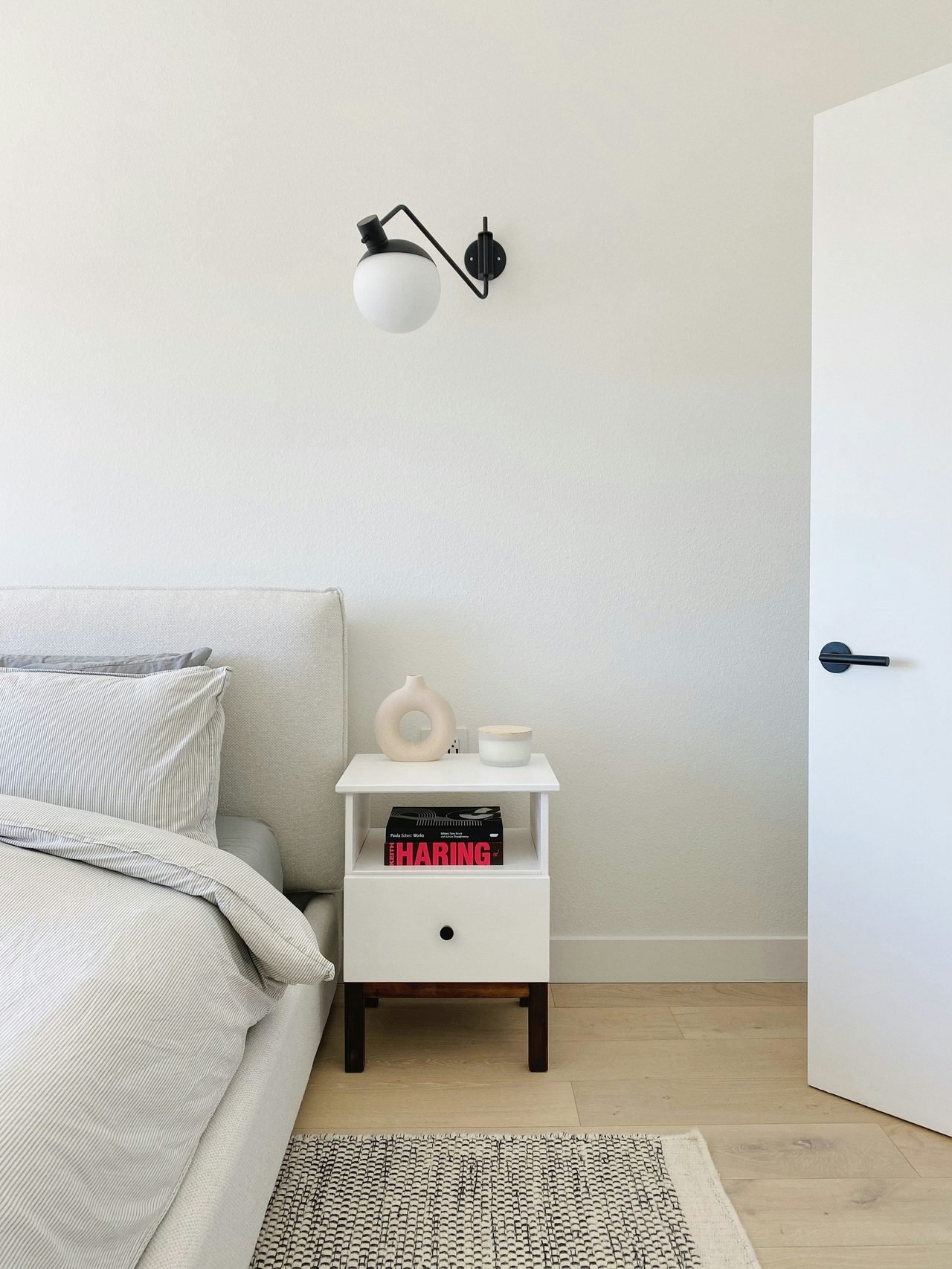
How to Style a White Nightstand So It Looks Expensive
11. Follow the Lamp Rule
The lamp is the anchor of the whole arrangement. For a standard 18–22 inch white nightstand, choose a lamp 24–30 inches tall with a shade that doesn’t extend past the tabletop edge. The bottom of the shade should sit roughly at your eye level when you’re sitting up in bed — that’s the sweet spot for reading light without glare. A nightstand with the right lamp looks styled even if that’s the only thing on it.
Good to know: a dimmable bulb or a 3-way lamp turns the same lamp into reading light and wind-down light — worth the extra few dollars for a bedroom.
Try it: If your nightstand is narrow, try a slim candlestick lamp or a wall sconce instead of a bulky base.
12. Stack Books, Then Top with an Object
Two or three books stacked horizontally, largest on the bottom, topped with something small — a candle, a tiny sculpture, a small dish. This is the oldest stylist trick in the book because it works: the stack adds height and color, the object adds personality. On a nightstand, book spines are your easiest source of color.
Good to know: vary the book sizes slightly and cap the stack at three — more than that starts to read as a pile rather than a style choice.
Try it: Pick books you actually like — guests always look at the spines, and it’s a conversation starter.
13. Corral Clutter on a Tray
A small tray — marble, wood, ceramic, rattan — turns the daily scatter (glasses, lip balm, phone, watch) into a deliberate arrangement. Everything on the tray reads as “styled”; the same items loose on the surface read as “messy.” On a nightstand, a wood or brass tray also adds the warm contrast white needs.
Good to know: choose a tray with a lip or raised edge — it keeps glasses and bottles from sliding off when you yank the drawer open in a hurry.
Try it: Size the tray to about a third of the tabletop so the nightstand still breathes.
14. Add Something Alive
A small plant, a sprig of eucalyptus in a bud vase, or fresh flowers — greenery against white is one of the freshest combinations there is. Low-maintenance picks that survive bedside life: succulents, snake plants, pothos, or dried stems if you have a black thumb. Just use a coaster or waterproof saucer — water rings are the enemy of white paint.
Good to know: if the nightstand gets zero natural light, go faux — a good faux eucalyptus stem looks real at arm’s length and never needs water.
Try it: A single stem in a small vase beats a big bouquet here; scale matters on a small surface.
15. Layer in Scent and Soft Light
A candle or reed diffuser adds the sensory layer that makes a bedroom feel finished — scent is styling you can’t see. Pair it with your lamp on a dimmer (or a warm-bulb lamp) and the whole corner glows. Lavender, vanilla, and cedar are the classic wind-down scents. Keep the candle away from the lamp shade and curtains, obviously.
Good to know: stick to unscented or lightly scented options if you’re sensitive — strong fragrance inches from your pillow can trigger headaches.
Try it: A candle in a lidded container looks tidier and keeps dust out of the wax.
What Pairs Well With a White Nightstand
A nightstand almost never stands alone — it’s part of a bedside composition. Here’s what to put around it so the whole corner looks intentional.
The bed itself. Nightstands pair with literally any bed, but they look best with some contrast: a navy or charcoal upholstered headboard, a warm oak or walnut frame, or a black metal frame. With an all-white bed, lean on texture — linen bedding, a chunky knit throw — so the corner doesn’t wash out into a white blur.
Bedding colors. White-on-white is classic hotel. White with sage green, dusty blue, or terracotta feels current and warm. White with black accents is timeless and a little dramatic. Rule of thumb: if your bedding is busy or heavily patterned, a plain white nightstand calms the visual noise; if your bedding is solid and quiet, the nightstand itself can carry more style — fluted fronts, mirrored panels, brass hardware.
The lamp. The lamp is the nightstand’s permanent partner — ceramic or linen shades for soft looks, black metal or brass for contrast. Aim for the combined lamp-plus-nightstand height to land around two-thirds of your headboard height; that proportion looks balanced from across the room.
A rug. A rug that slides under both nightstands ties the two sides of the bed together and makes the whole arrangement look planned. In a small room where a full rug won’t fit, even a runner along one side of the bed does the job.
The wall above. The 12–18 inches of wall above a nightstand is prime real estate: a small framed print, a plug-in sconce, or a round mirror. A mirror is my favorite move — it doubles the light the white finish reflects and makes the whole corner glow.
Why White Nightstands Turn Yellow (and How to Stop It)
Here’s the thing most buying guides won’t tell you: white painted furniture can yellow over time, and it’s the number one complaint I hear about nightstands. The culprits are oil-based paints and finishes (they amber as they cure), direct sunlight, heat from lamps, and cigarette or cooking smoke. Once it happens, it’s hard to reverse — so prevention is everything.
How to keep your nightstand white:
- Choose water-based finishes. When buying, look for “water-based” or “acrylic” paint/lacquer in the product details — they resist yellowing far better than oil-based.
- Keep it out of direct sun. UV accelerates yellowing. If the nightstand sits in a sunny spot, sheer curtains are enough protection.
- Clean gently and regularly. Dust with a dry microfiber cloth; wipe smudges with a damp cloth and mild soap. A melamine sponge (like a Magic Eraser) lifts scuffs, but use it lightly — it can dull glossy finishes.
- Keep a touch-up pen handy. A white furniture touch-up marker hides chips before they spread. Match the undertone (bright white vs. creamy white) or the spot will stand out.
- Give lamps breathing room. A hot bulb sitting inches from white paint for years will discolor it — LED bulbs run cooler and solve this completely.
One more thing worth knowing: not all “white” finishes are the same color, and this matters when you’re buying a pair or matching an existing dresser. Bright white has a crisp, almost blue undertone; antique or creamy white leans warm and yellow. Hold a plain white sheet of paper against the finish in natural light before you commit — if the nightstand looks dingy next to the paper, it’s a warm white, and it will never match a bright-white piece no matter what the product name says.
Common Mistakes to Avoid
- Buying before measuring mattress height. The most common and most regrettable mistake. Measure floor to mattress top with the bed fully made, and shop for a nightstand within 2–4 inches of that number. Eyeballing it in the store is how you end up with a nightstand that looks like doll furniture next to your bed.
- Ignoring drawer clearance. That beautiful 2-drawer white nightstand is useless if the bottom drawer can’t open because it hits the bed frame or wall. Check the swing space in front — drawers need their full depth plus a few inches.
- Choosing high-gloss when you hate cleaning. High-gloss white looks stunning in photos and shows every fingerprint, dust speck, and smudge in real life. Be honest about your cleaning habits: matte or satin for low-maintenance people.
- Skipping the anti-tip kit on tall pieces. A tall, narrow white nightstand with drawers full of books is a tipping hazard, especially with kids or climbing pets. The strap takes five minutes to install.
- Buying one now, one later. Whites don’t match across production runs — “white” from the same brand six months apart can be visibly different. If you want a pair, buy them together.
- Overcrowding the top. A nightstand’s charm is its clean look. Lamp + one or two styled items is the formula; once you add the water bottle, the remote, the stack of mail, and the half-read magazines, it just looks cluttered. Corral the daily stuff on a tray or in the drawer.
- Forgetting the walkway. Squeezing an oversized white nightstand into a tight spot means bruised shins and blocked drawers. Keep 24 inches of clear path beside the bed, even if it means going narrower than you’d like.
White Nightstand at a Glance
| # | Style | Typical Size (W × D × H) | Best For | Price Tier |
|---|---|---|---|---|
| 1 | Modern Minimalist 2-Drawer | 18–20″ × 15–16″ × 24–26″ | Scandinavian/modern bedrooms | $–$$ |
| 2 | Farmhouse with Wood Top | 20–24″ × 16–18″ × 26–28″ | Cozy, rustic, family rooms | $–$$ |
| 3 | Mid-Century Tapered Legs | 18–22″ × 14–16″ × 24–26″ | Platform beds, retro style | $$–$$$ |
| 4 | Coastal Distressed | 20–24″ × 16–18″ × 26–28″ | Beachy, relaxed bedrooms | $–$$ |
| 5 | Mirrored Glam | 20–24″ × 14–16″ × 26–28″ | Small dark rooms, drama | $$–$$$ |
| 6 | Fluted Statement | 16–20″ × 14–16″ × 22–24″ | Designer look on a budget | $$ |
| 7 | Narrow (Under 16″) | 12–15″ × 13–15″ × 22–26″ | Tight gaps, apartments | $–$$ |
| 8 | Tall Slim 3-Drawer | 14–16″ × 14–16″ × 28–32″ | Max storage, small footprint | $$–$$ |
| 9 | Floating Wall-Mounted | 16–20″ × 10–14″ × custom | Tiny rooms, easy cleaning | $–$$ |
| 10 | Matching Set of 2 | varies | Symmetrical, finished look | $$ |
| 11–15 | Styling ideas (lamp, books, tray, greenery, scent) | — | Any white nightstand | $ |
FAQ
What height should a nightstand be?
Match it to your bed: the top of the nightstand should sit within 2–4 inches of the top of your mattress, measured with the bed fully made. Most standard nightstands are 24–28 inches tall, which suits mattresses in the 24–30 inch range. If your mattress is unusually tall or low, shop by your measurement, not by the “standard” label. And re-measure if you add a thick mattress topper later — even two extra inches can throw off the reach.
Do my nightstands have to match?
No — but they should relate. A matching pair of nightstands is the safest, calmest choice, especially in a primary bedroom. If you mix, keep one element consistent: same white finish, same height, or same style family. Two completely different nightstands at different heights looks accidental, not eclectic. One exception: in a kids’ room or guest room, a single nightstand on one side is perfectly fine — symmetry matters most in the primary bedroom.
How do I keep a nightstand from turning yellow?
Buy pieces with water-based (acrylic) finishes rather than oil-based, keep the nightstand out of prolonged direct sunlight, and clean it regularly with a damp cloth and mild soap. Switch bedside bulbs to LED — they run cooler and won’t heat-discolor the paint over time. If yellowing has already started on an oil-based finish, light sanding plus a fresh coat of water-based white paint is the only real fix.
What size lamp goes on a nightstand?
For a standard 18–22 inch wide white nightstand, choose a lamp 24–30 inches tall overall, with a shade no wider than the tabletop. The bottom edge of the shade should sit about at your eye level when you’re sitting up in bed. On narrow nightstands under 16 inches wide, go slim — a candlestick lamp or a wall-mounted sconce. And choose a warm white bulb (2700K) for the bedroom; cool daylight bulbs feel harsh next to a bed.
Can I use a nightstand in the living room?
Absolutely — it’s one of the most versatile pieces you can own. A nightstand works as an end table beside a sofa or reading chair, a hallway catch-all, or even a small entryway table. The white finish blends into living room palettes just as easily as bedroom ones. Just make sure the height works next to your sofa arm — side tables should sit within a couple inches of the armrest height, the same rule as beside a bed.
How wide should a nightstand be for a queen bed?
For a queen bed, look for a nightstand 18–22 inches wide. That gives you room for a lamp plus a few essentials without overwhelming the bed. If your bedroom is tight, you can go as narrow as 14–16 inches and reclaim the surface space with a wall sconce instead of a table lamp. Just don’t go narrower than 12 inches if you still want a drawer — below that, the drawer box gets too small to be useful.
Is solid wood or MDF better for a nightstand?
Solid wood is more durable, heavier, and holds paint better over time — it’s the buy-it-once option. MDF or engineered wood with a quality paint finish is perfectly fine for a bedside table that holds a lamp and books, and it costs significantly less. Either way, check that the drawers glide smoothly and the piece doesn’t wobble. If you’re buying online, filter reviews for the words “sturdy” and “drawers” — that’s where the truth about build quality hides.
How do I style a nightstand without it looking cluttered?
Follow the three-item formula: a lamp (the anchor), one vertical element (stacked books, a small plant, or a framed photo), and one small personal item corralled on a tray. Everything you use daily — glasses, chargers, meds — lives in the drawer or on the tray, not scattered across the top. And give the top a 30-second reset each morning when you make the bed; it’s the easiest styling habit you’ll ever build.
Final Thoughts
A nightstand is a small piece that does an outsized job — and now you know exactly how to choose one: measure your mattress height first, pick a finish for your real cleaning habits, and style it with the lamp-plus-three formula. Whether you go farmhouse, mid-century, or glam mirrored, white gives you a bright, flexible base that works with whatever bedding you fall for next.
If I had to boil this whole guide down to three moves, they’d be these: measure your mattress height before you shop, buy the best drawer glides your budget allows, and style the top with the lamp-plus-three formula. Do those three things and even an affordable white nightstand will look like you hired someone.
Which of these 15 white nightstand ideas is going in your bedroom first? Start with the measuring tape — everything good follows from that.

Founder of NestFlavors — sharing tested recipes and honest home ideas, made for real life.