

The right reading chair turns twenty stolen minutes into the best part of your day.
A reading chair isn’t just a seat — it’s the anchor of your reading nook, the spot your whole evening routine orbits around. But pick the wrong one and you’ll know within a week: the seat’s too deep to sit upright, the arms are too low to rest a book on, or it swallows your small bedroom whole.
I’ve sat in (and styled) dozens of reading chairs over the years, from $150 slipper chairs to heirloom wingbacks. This guide covers the 12 best types of reading chairs — what each one is, who it’s for, the dimensions that matter, and how to style it into a nook you’ll actually use.
What Is a Reading Chair?
A reading chair is a comfortable single-seat chair designed for extended sitting — with supportive back cushioning, armrests, and proportions that let you shift between upright reading and relaxed lounging. Unlike a dining chair (built for short sits) or an office chair (built for task posture), a reading chair is made for the long, slow pleasure of finishing “just one more chapter.”
The best reading chair supports at least three postures: upright for focused reading, a slight recline for lazy afternoons, and feet elevated for full wind-down mode. Get those three right and everything else is style.
Why You’ll Love These Reading Chair Ideas
- Real comfort, not showroom comfort — every type below is judged on how it feels at minute 90, not minute 5.
- Every budget covered — from $150 small-space finds to investment pieces worth handing down.
- Renter-friendly — no built-ins, no renovations; every idea works in a rental apartment.
- Dimensions included — so you can measure your corner before you fall in love.
- Styling built in — fabric, placement, and pairing tips for each chair type.
- Small spaces welcome — half the list is specifically chosen for apartments and bedrooms.
How to Choose a Reading Chair: 5 Rules
Before you fall for a silhouette, run every contender through these five checks. They take ten minutes and they’ll save you from the most common buyer’s remorse in furniture.
1. Match the seat depth to your legs. This is the single most important measurement. Sit all the way back: you want 2–3 inches between the front edge of the seat and the back of your knees. Too deep and you’ll slouch to reach the backrest (hello, backache); too shallow and you’ll perch. Most adults land in the 20–24 inch range, but if you’re under 5’4″, look for 19–21 inches, and if you’re over 6’1″, look for 23–26.
2. Check the fabric’s rub count. Durability is measured in “double rubs” (one back-and-forth on a testing machine). For a chair you’ll sit in daily, 15,000+ double rubs is the minimum; 25,000+ is genuinely long-lasting. The listing won’t always show it — check the manufacturer’s specs page, not just the retailer. Performance fabrics, leather, and tight weaves score highest; loose linen and cheap velvet score lowest.
3. Inspect the frame construction. Kiln-dried hardwood frames (oak, maple, beech) outlast engineered wood and soft pine by years. You can’t see the frame, so read the specs: “solid wood frame” or “kiln-dried hardwood” is what you want; “wood composite” or no mention at all is a red flag at higher price points. Weight capacity is a decent proxy — chairs rated 300+ lbs usually have real frames behind them.
4. Sit-test the arm height. For reading, armrests should land where your elbows naturally rest while holding a book — typically 24–26 inches from the floor, or about 7–9 inches above the seat cushion. Too high and your shoulders hunch; too low and your arms dangle. If you’re buying online, compare the numbers to a chair you already like sitting in.
5. Think about the third posture. Ask yourself: “Where do my feet go?” If the chair has no recline and you won’t buy an ottoman, your legs will get restless by chapter three. Either choose a chair with a matching ottoman, budget for a standalone one, or pick a recliner/chaise that handles leg support itself.
Try it: Keep a notes app list of your non-negotiable measurements (seat depth, max width for your space, fabric type) and check every listing against it before you let yourself look at the photos.
Classic & Timeless Reading Chairs
These are the silhouettes that have survived centuries because they work. If your style leans traditional, transitional, or “library with a ladder” dreams, start here.
1. The Wingback Chair: The Classic Reading Throne
Picture every cozy mystery novel ever written — the detective reads in a wingback. Originally designed in 17th-century England to shield sitters from drafts, the high back and wraparound “wings” create a private little cocoon. That enclosure is exactly why it works so well as a reading chair: it blocks peripheral distraction and cradles your head when you lean back.
Why it works: The tall back (typically 40–46 inches high) supports your head and neck during long sessions, and the wings give you a place to rest your temple when you’re thinking about what you just read. Look for a seat depth of 20–24 inches — deep enough to curl a leg under you, shallow enough to sit upright without a pillow behind your back.
Dimensions & price: Usually 28–34 inches wide, 30–36 inches deep. Expect $400–$1,500 depending on fabric and frame quality.
Best for: Bedrooms, living room corners, and home libraries. A wingback in a performance velvet or linen reads classic without feeling stuffy.
Styling tip: Pair with a slim brass floor lamp and a small round side table. A lumbar pillow in a contrasting texture (think leather against linen) keeps the tall back from looking flat.
Try it: Angle the chair 45 degrees to a window instead of facing the room — you get natural light over your shoulder and the room gets a styled corner.
2. The Leather Club Chair: Old-School Cool
The club chair is the wingback’s rowdier cousin — deep, low, and upholstered, with a rolled back and arms at nearly the same height. Traditionally leather, it’s the chair that looks better the more you use it. A well-worn club chair with a good book on the arm is basically a personality trait.
Why it works: The low, deep seat (often 22–26 inches deep) encourages the full sprawl — feet up, book on chest, zero regrets. Leather breathes better than most people expect, so it doesn’t get clammy in summer the way cheap faux leather does. Full-grain or top-grain leather will outlast fabric by a decade or more.
Dimensions & price: Typically 30–36 inches wide, 32–38 inches deep — this is a big chair, so measure twice. Real leather runs $800–$2,500; quality bonded or vegan alternatives land around $400–$800.
Best for: Home offices, dens, and living rooms with a masculine or vintage edge. Needs visual space around it — don’t wedge it into a tight corner.
Styling tip: Balance the heaviness with something light nearby — a glass-top side table, a linen throw, or a tall arc lamp. Leather + warm wood + one soft textile is the whole formula.
Try it: Condition the leather twice a year (15 minutes, that’s it) and it will develop a patina that no new chair can fake.
3. The Rocking Chair (or Glider): Gentle Motion, Deep Calm
Don’t file this under “nursery only.” A modern rocking chair or glider — clean lines, upholstered seat, wood or metal rockers — is one of the most genuinely relaxing reading chairs you can own. The gentle motion settles your nervous system, which is exactly what you want before sleep reading.
Why it works: Rocking engages your core just enough to keep you from going full-slouch, and many readers find the rhythm helps focus. Gliders (which move on a fixed track rather than curved rockers) are better for small spaces since they don’t travel across the floor. Look for a high enough back to support your head — cheap rockers skimp here.
Dimensions & price: Usually 26–32 inches wide, 34–40 inches deep (rockers need clearance behind). $200–$900 for upholstered models.
Best for: Bedrooms, nurseries that need to grow up, and anyone who reads to fall asleep. Also great for back-pain sufferers who can’t sit still.
Styling tip: A rocker can read “grandma” fast, so keep the fabric modern — bouclé, performance linen, or a muted velvet. A small rug underneath anchors it and protects floors.
Try it: Place it where it catches the last light of the day. Evening reading in a rocking chair by a west-facing window is a top-tier life experience.
Modern & Minimalist Reading Chairs
Clean lines, honest materials, and nothing you don’t need. These reading chairs suit Scandinavian, Japandi, mid-century, and contemporary spaces — and several are apartment-sized by design.
4. The Scandinavian High-Back Lounge Chair
Think of the classic Danish lounge chair: sculptural wood frame, tall upholstered back, seat cushion that looks thin but sits like a dream. These chairs prove that a reading chair doesn’t need bulk to be comfortable — it needs the right angles.
Why it works: The magic is in the recline angle (usually 100–110 degrees) and a seat height around 15–16 inches, which lets your feet rest flat while your back stays supported. The high back supports your head without a pillow. Wool and leather versions age beautifully and ventilate well, so you won’t overheat during a long read.
Dimensions & price: Typically 28–32 inches wide, 30–34 inches deep — visually light thanks to exposed legs. $500–$2,000 for solid wood frames; flat-pack versions run $250–$500.
Best for: Minimalist living rooms, reading corners that need to look curated, and design lovers who notice joinery.
Styling tip: Let the chair be the sculpture. One sheepskin throw over the arm, a paper-shade floor lamp, and nothing else. Resist the urge to clutter around it.
Try it: If the seat feels firm at first, give it two weeks — high-density foam breaks in, and your posture will thank you.
5. The Barrel Chair: A Hug in Furniture Form
A barrel chair wraps a curved back around three sides, like sitting inside a parenthesis. It’s the introvert’s reading chair — cozy, enveloping, and visually softer than a wingback. The 360-degree swivel versions add a playful “turn toward the conversation (or away from it)” energy.
Why it works: The curved back supports your sides as well as your back, which means you can lean sideways with a book and still feel held. The compact footprint (many are under 30 inches wide) makes it one of the best reading chairs for small spaces. Swivel bases are genuinely useful — pivot toward the window for daylight, back toward the room for company.
Dimensions & price: Usually 28–32 inches wide, 28–32 inches deep. $250–$900.
Best for: Apartments, bedrooms, and living rooms where the chair needs to look good from every angle (open floor plans, take note).
Styling tip: Barrel chairs love round companions — a round side table, a round rug, an arc lamp. The curves echo each other and the corner feels intentional.
Try it: The swivel version in a bouclé or chenille fabric is the sweet spot: tactile, modern, and endlessly photogenic.
6. The Swivel Accent Chair: Turn Toward the Light
A swivel accent chair is exactly what it sounds like — a stylish armchair on a 360-degree rotating base. For readers, the swivel isn’t a gimmick; it solves the eternal problem of chasing good light. Morning sun on the east side, evening lamp on the west side — just turn.
Why it works: You get the upright posture of an accent chair with the flexibility of a recliner’s lifestyle. Look for a seat depth of 20–22 inches and armrests at 24–26 inches high — high enough to prop your elbows while holding a book, low enough to slide under a side table. Memory foam or high-resiliency foam cushions hold their shape through daily use.
Dimensions & price: Compact — many are 26–30 inches wide and under 32 inches deep. $200–$700.
Best for: Multipurpose rooms, home offices that double as reading spots, and renters (light enough to move solo, small enough for any corner).
Styling tip: Since the chair rotates, style all four sides — no ugly back. A bold fabric (emerald velvet, rust chenille) turns it into the room’s exclamation point.
Try it: Put the swivel chair between two light sources — a window and a floor lamp — and you’ll use every degree of that rotation.

Maximum-Comfort Reading Chairs
If your reading sessions regularly pass the two-hour mark, comfort stops being a preference and becomes a requirement. These three prioritize your body above all else.
7. The Wall-Saver Recliner: Full Lounge, Zero Bulk
The old recliner stereotype — bulky, beige, La-Z-Boy energy — is dead. Modern wall-saver (also called wall-hugger) recliners need just 2–4 inches of wall clearance to fully recline, and they come in fabrics that belong in a design magazine: top-grain leather, performance linen, even bouclé.
Why it works: This is the only chair type that truly nails all three reading postures — upright, reclined, and feet-elevated — with a lever or button. The footrest changes everything for circulation during long reads. Look for a recline range of at least 110–160 degrees and a weight capacity that exceeds your needs by 50+ pounds (mechanisms last longer when they’re not maxed out).
Dimensions & price: Upright footprint is modest (30–34 inches wide, 34–38 inches deep), but allow 60–65 inches of depth when fully reclined. $400–$1,800.
Best for: Dedicated readers, anyone with back or circulation issues, and living rooms where the chair pulls TV duty too.
Styling tip: Choose tailored details — track arms, a tight back, tapered wood legs — and nobody will clock it as a recliner. Drape a throw over the back to soften the mechanism’s lines.
Try it: Test the recline in person if you can. The difference between a $400 and $900 mechanism is smoothness you feel every single day.
8. The Chaise Lounge: Stretch Out and Stay Awhile
A chaise lounge is a long chair that supports your whole body — part seat, part daybed. For readers, it’s the closest thing to reading in bed without the “I fell asleep on page 12” problem. The extended seat means your legs are fully supported, which takes pressure off your lower back.
Why it works: Full leg support is the chaise’s superpower. Most reading chairs leave your calves dangling or demand an ottoman; a chaise just handles it. The single-arm (méridienne) style looks elegant and gives you a natural book-prop. Velvet and linen upholstery keep it from reading “doctor’s office.”
Dimensions & price: Long — typically 24–30 inches wide and 55–65 inches long. It needs a wall or a long stretch of floor. $350–$1,500.
Best for: Bedrooms (at the foot of the bed is classic), long living room walls, sunrooms, and tall readers who never fit in standard chairs.
Styling tip: A chaise begs for a throw blanket draped lengthwise and a floor lamp arched over the middle. Keep the palette tonal — creams, caramels, soft grays — for that exhale feeling.
Try it: If floor space is tight, a “chaise end” sectional piece or a narrow 24-inch-wide chaise fits where a full one won’t.
9. The Chair-and-Ottoman Pair: The 3-Posture Setup
Here’s a secret from furniture designers: the ottoman matters as much as the chair. Almost any good armchair becomes a great reading chair when you add a matching ottoman, because elevating your feet is the third posture your body craves — and the one most chairs ignore.
Why it works: Feet elevated takes pressure off your lumbar spine and improves circulation, which is why your legs get restless in a chair without one. An ottoman also gives you options: feet up for novels, feet down for focused nonfiction, sideways for phone scrolling between chapters. Bonus: it doubles as extra seating when guests come over.
Dimensions & price: Ottoman adds roughly 20–26 inches wide by 16–20 inches deep in front of your chair. Matching ottomans run $100–$400; the pair together typically $400–$1,200.
Best for: Literally everyone. If you already own a chair you like, an ottoman is the cheapest reading-nook upgrade in existence.
Styling tip: The ottoman doesn’t have to match exactly — a leather ottoman with a fabric chair (or vice versa) adds that collected-over-time designer feel. A small tray on top turns it into a coffee table in a pinch.
Try it: Height matters: the ottoman top should sit 1–2 inches below your chair seat. Too tall and your knees hike up; too low and your legs dangle.
Small-Space & Budget Reading Chairs
Small apartment? Tight bedroom corner? These reading chairs prove you don’t need square footage or a big budget — you need the right proportions.
10. The Slipper Chair: Small Footprint, Big Style
The slipper chair is the minimalist’s answer: armless, low to the ground, and barely wider than you are. Originally designed for Victorian bedrooms (easy to slip in and out of while dressing — hence the name), it’s now the go-to reading chair for small spaces because it visually disappears.
Why it works: No arms means no visual bulk and no bruised hips squeezing past it in a tight room. The low seat height (often 15–17 inches) keeps sightlines open, so your room feels bigger. What you lose in arm support, you gain in placement freedom — it tucks under console tables, floats in the middle of rooms, and slides into closets-turned-nooks.
Dimensions & price: Wonderfully compact — 24–28 inches wide, 26–30 inches deep. $150–$600.
Best for: Studio apartments, bedroom corners, dorm rooms, and reading nooks carved out of closets or alcoves.
Styling tip: Since there’s no arm to drape things over, style around it — a floor cushion beside it, a wall-mounted reading light above, a narrow side table within reach. Add a lumbar pillow; armless chairs need the back support.
Try it: Two slipper chairs facing each other across a small round table make an instant conversation-and-reading corner that seats two in the space of one armchair.
11. The Papasan Chair: The Cozy Bowl
The papasan — that big round bowl cushion on a rattan or wood frame — is pure comfort nostalgia. It looks like a nest because it basically is one. Modern versions come in clean fabrics and streamlined frames that fit right into boho, coastal, and eclectic spaces.
Why it works: The bowl shape lets you sit cross-legged, sideways, curled up — every position a dedicated reader cycles through. The deep cushion (often 6+ inches of fill) is forgiving on hips and tailbones. It’s also one of the most affordable genuinely-comfortable reading chairs: the frame lasts for years and replacement cushions are cheap.
Dimensions & price: Big and round — typically 40–46 inches in diameter. It needs floor space but no wall clearance. $120–$400.
Best for: Boho and eclectic bedrooms, teen rooms, sunrooms, and anyone who reads cross-legged.
Styling tip: Lean into the texture story: rattan frame, chunky knit throw, jute rug underneath. Keep the cushion cover washable — you’ll live in this chair.
Try it: The 360-degree swivel papasan frames are worth the small upcharge. Being able to turn toward the light without standing up is a daily joy.
12. The Bouclé Accent Chair: Texture That Invites Touch
Bouclé — that nubby, looped wool-like fabric — is the defining textile of current interiors, and for good reason: it looks like a cloud and wears like iron. A mid-century-style accent chair in cream bouclé is the reading chair all over Pinterest right now, and unlike most trends, this one earns it on comfort.
Why it works: The nubby texture adds grip, so you don’t slide around the way you do on smooth velvet or leather. Bouclé hides wear remarkably well — the texture camouflages the compression that makes flat fabrics look tired. The typical mid-century frame (tapered wood legs, curved back) hits the ergonomic sweet spot for upright reading.
Dimensions & price: Usually 28–32 inches wide, 30–34 inches deep. $300–$900.
Best for: Living rooms and bedrooms that need a style moment, neutral palettes that need texture, and anyone whose chair will be photographed (no judgment — we all do it).
Styling tip: Cream bouclé + black accents (lamp, side table, frames) is the foolproof formula. Add one warm element — cognac leather pillow, oak tray — so it doesn’t feel cold.
Try it: Check the rub count before buying (15,000+ double rubs for daily reading use). Cheap bouclé pills; good bouclé lasts a decade.
The Reading Nook Triangle: Chair + Light + Table Rules
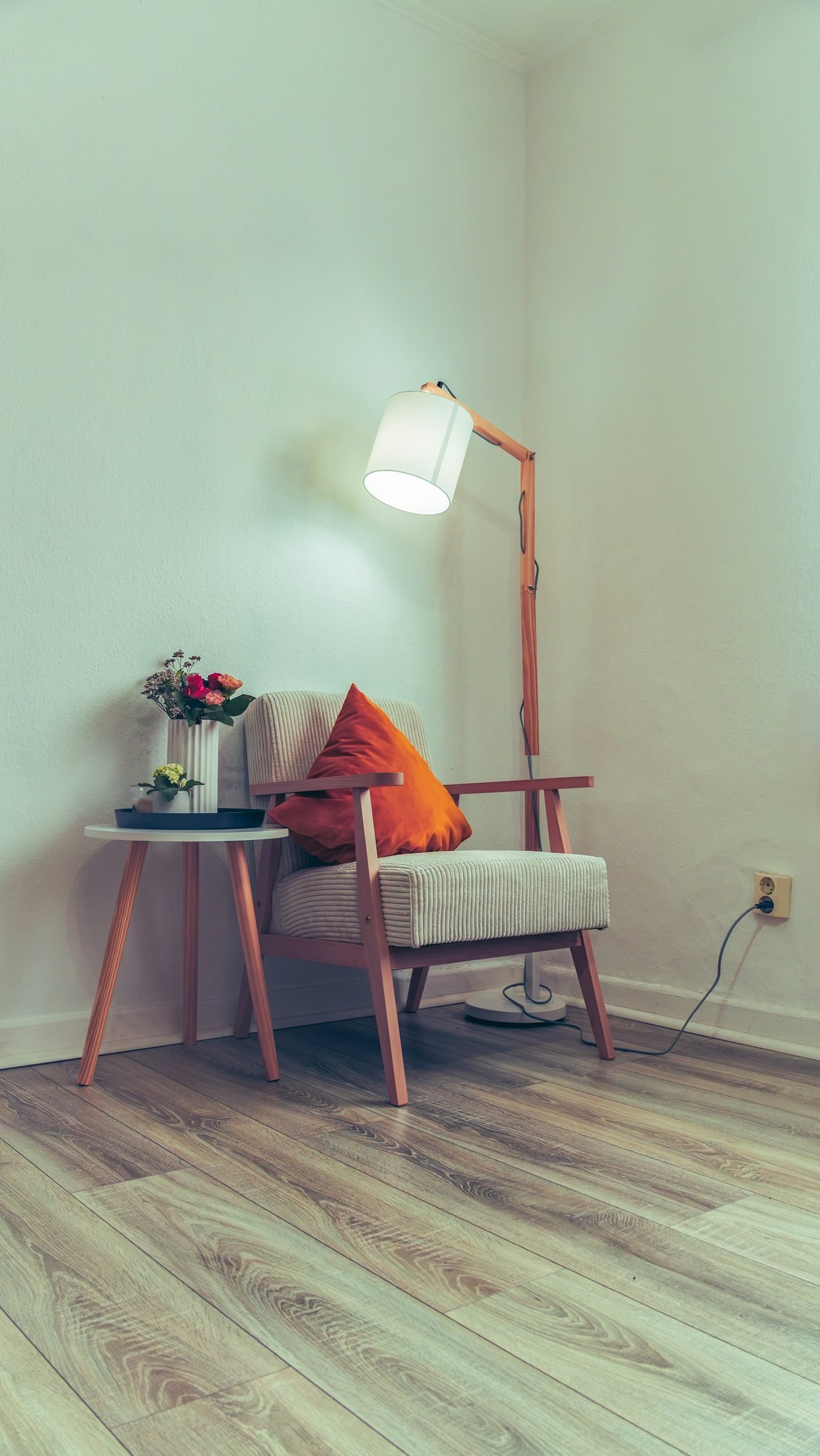
Here’s what most reading chair guides skip: the chair is only one-third of the equation. A perfect chair with bad light and nowhere to put your tea is a failed nook. I call it the Reading Nook Triangle — chair, light, and surface — and getting the geometry right matters more than which chair you pick.
The triangle, measured:
- Chair to light: Your reading light should sit 12–18 inches behind and slightly to the side of your shoulder — opposite your dominant hand, so your hand never casts a shadow on the page. The bottom of the shade should be at about eye level when you’re seated (roughly 40–48 inches from the floor for most chairs).
- Chair to table: Your side table should be within a 24-inch reach — close enough to grab your mug without leaning. Table height should match your chair’s armrest height (usually 22–26 inches) so setting things down is one smooth motion.
- Chair to wall: Leave 3–6 inches behind the chair for recliners and rockers; stationary chairs can sit closer. In front, you need 30–36 inches of clear floor for your legs and an ottoman.
- Light quality: Aim for 300–500 lux at page level (most floor lamps with a 60W-equivalent bulb get you there) in a warm 2700–3000K color temperature. Cool white light feels like an office; warm light feels like evening. A dimmer is worth every penny — bright for small print, low for winding down.
The renter-friendly version: One good chair, one plug-in wall sconce or arc floor lamp (no wiring needed), and one small round table. That’s the whole nook. Everything else — the throw, the plant, the stack of books — is decoration.
Try it: Sit in your chair with a book at 9pm before you finalize placement. Daylight lies; evening light tells the truth about glare and shadows.
The fourth layer: texture. Once the triangle is set, add one throw blanket and one lumbar or throw pillow — that’s the styling layer that makes a nook feel finished in photos and in real life. Choose textures that contrast the chair: a chunky knit throw on leather, a smooth linen pillow on bouclé. Washable covers are non-negotiable if this is your everyday seat; even the most careful reader spills tea eventually. A small lidded basket beside the table corrals the current read, the next read, and the charger cable, keeping the whole corner tidy without any real effort.
Common Mistakes to Avoid
- Buying for looks alone. The sculptural chair that’s agony after 20 minutes will become a very expensive coat rack. Sit-test for at least 15 minutes, or buy from somewhere with a real return policy.
- Ignoring seat depth. Too deep (26+ inches) and short readers can’t sit upright without a pillow; too shallow (under 19 inches) and tall readers perch instead of settling. Match depth to your body: your back should touch the backrest with 2–3 inches between the seat edge and your knees.
- Forgetting the light. The number one reason reading nooks go unused. A beautiful chair in a dark corner is furniture; a decent chair with perfect light is a habit.
- Skipping the side table. You’ll need somewhere for the book, the tea, the glasses, and the phone. No surface within reach = getting up constantly = nook abandoned.
- Choosing the wrong fabric for your life. White linen with toddlers and a golden retriever is a cry for help. Performance fabrics, leather, and darker bouclé exist for a reason — match the textile to your household, not your Pinterest board.
- Blocking the room’s flow. A 36-inch-deep club chair in a 24-inch walkway is a daily annoyance. Measure your traffic paths first: you need at least 30 inches of clear walkway around the chair.
- Going too matchy. A chair, ottoman, lamp, and table all in the same finish looks like a showroom, not a home. Mix two materials minimum — wood + metal, fabric + leather, matte + brass.
Reading Chairs at a Glance
| # | Chair Type | Best For | Typical Footprint | Typical Price |
|---|---|---|---|---|
| 1 | Wingback | Classic bedrooms & libraries | 28–34″ W × 30–36″ D | $400–$1,500 |
| 2 | Leather club chair | Dens & vintage style | 30–36″ W × 32–38″ D | $800–$2,500 |
| 3 | Rocking chair / glider | Bedrooms & bedtime reading | 26–32″ W × 34–40″ D | $200–$900 |
| 4 | Scandinavian lounge | Minimalist spaces | 28–32″ W × 30–34″ D | $250–$2,000 |
| 5 | Barrel chair | Apartments & open plans | 28–32″ W × 28–32″ D | $250–$900 |
| 6 | Swivel accent chair | Multipurpose rooms & renters | 26–30″ W × ~32″ D | $200–$700 |
| 7 | Wall-saver recliner | Long sessions & back pain | 30–34″ W × 34–38″ D | $400–$1,800 |
| 8 | Chaise lounge | Bedrooms & tall readers | 24–30″ W × 55–65″ L | $350–$1,500 |
| 9 | Chair + ottoman | Everyone (best upgrade) | Chair + ~24″ × 18″ | $400–$1,200 pair |
| 10 | Slipper chair | Studios & tight corners | 24–28″ W × 26–30″ D | $150–$600 |
| 11 | Papasan chair | Boho & cross-legged readers | 40–46″ diameter | $120–$400 |
| 12 | Bouclé accent chair | Style-forward living rooms | 28–32″ W × 30–34″ D | $300–$900 |

FAQ
What is the most comfortable type of reading chair?
For pure long-session comfort, a wall-saver recliner or a quality wingback with an ottoman wins — both support upright, reclined, and feet-elevated postures. That said, the “most comfortable” chair is the one sized for your body: correct seat depth and lumbar support beat any style category. If you read mostly in short bursts, comfort differences between types shrink — pick the one that fits your room and makes you want to sit down.
What size should a reading chair be?
Most adults are comfortable in a chair 28–34 inches wide with a seat depth of 20–24 inches and a seat height of 16–18 inches. Your back should touch the backrest with 2–3 inches of space between the seat edge and the back of your knees. When in doubt, sit-test before buying.
Is a recliner or an armchair better for reading?
A recliner is better for long, relaxed reading sessions because of the adjustable positions and footrest. A well-chosen armchair (especially with an ottoman) is better if you also want style versatility, a smaller footprint, and easier rearranging. Many serious readers end up with both in different rooms.
What fabric is best for a reading chair?
For daily reading, look for durability first: performance fabrics (15,000+ double rubs), top-grain leather, or quality bouclé. Velvet and chenille feel luxurious but show wear faster in light colors. If you have kids or pets, performance linen or leather will save you grief.
How much should I spend on a reading chair?
Budget $200–$400 for a solid small-space chair (slipper, papasan, basic swivel), $400–$900 for a quality everyday reading chair, and $900+ for investment pieces (leather club chairs, designer lounge chairs). The mechanism quality on recliners is where extra money shows most. One more thing: budget $75–$150 extra for the light and side table if you don’t own them yet — a great chair with no light is money half-spent.
Where should I put a reading chair?
The best spot has three things: good light (near a window or with a dedicated lamp), a wall or corner behind it for coziness, and low foot traffic so you’re not in the way. Bedroom corners, living room corners angled to a window, and the foot of the bed are the classics.
Do I need an ottoman with my reading chair?
You don’t need one, but your back will notice the difference. Elevating your feet reduces lumbar pressure and improves circulation during long reads. If your chair didn’t come with one, a standalone ottoman ($100–$400) is the single cheapest comfort upgrade you can make.
How do I style a reading nook in a small apartment?
Think triangle: chair + light + small surface, all within a 4×4-foot area. Use a slipper or barrel chair (small footprint), a plug-in wall sconce instead of a floor lamp (zero floor space), and a round side table or even a sturdy ottoman with a tray. A rug underneath visually claims the nook from the rest of the room.
Final Thoughts
The perfect reading chair isn’t the most expensive one or the prettiest one — it’s the one that makes you sit down with a book instead of your phone. Measure your space, be honest about how you actually sit, and don’t skip the light.
Which type is calling your name? Start with the triangle — chair, light, table — and build your nook around the way you really read.

Founder of NestFlavors — sharing tested recipes and honest home ideas, made for real life.